





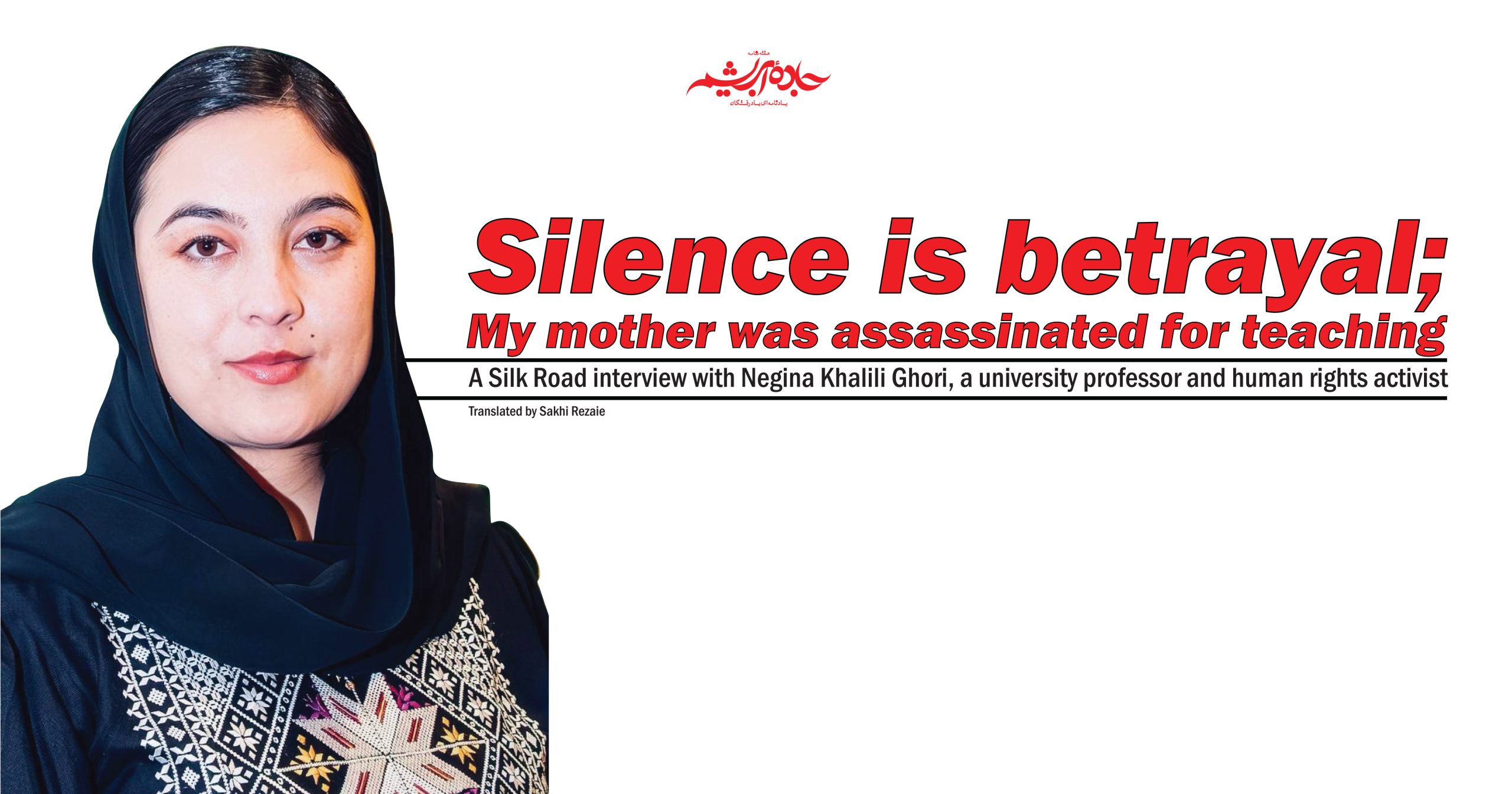
A Silk Road interview with Negina Khalili Ghori, a university professor and human rights activist
Translated by Sakhi Rezaie
 Note: Abeda, a 20-year-old girl who set herself on fire, many girls in Ghor reacted bitterly to it, wishing they were in her place and freed from the pain of womanhood. In the eyes of many women and girls in Ghor Province, Abeda is considered lucky. Because at least she did not drink acid while being beaten by her parents, she was not hanged by the men of the family, she did not become the wife of several old men who were older than their father, she did not have a blood price as the inheritance of a dead brother, she did not marry her husband’s brother. At least she had some fuel and gasoline to burn herself to save herself from forced marriage and from sleeping with old Taliban men.
Women/girls of Ghor, having been trapped in the clutches of a long-standing misogynistic tradition for years, even centuries, and now that they have fallen into the trap of the Taliban’s ethnic ideology and religious illusions, their fate has reached a point where many women and girls in Ghor, in the dilemmas of their lives, think not of home, life, freedom, love, and children, but of oil, rope, and suicide pills.
For years, women in Ghor have had no voice; because they are suffocated before they can express their voice and language, nor have they found a religious or political support. For years, many areas of Ghor, from the center to the far reaches, have been mysterious and inaccessible areas where we have not heard much about the condition of women. But their only voice has been suicide. The forests of local mullahs and the geography of religious men’s domination have in fact been and are the pastures of women and the hunting grounds of girls. Ghori women and girls have either lived like slaves; because they had no will or opportunity to express their demand, or they have been serving and working like maids and maidservants in their husbands’ houses without any accepted rights or privileges, or they have been bought and sold like sexual goods in the cunning market of lust. Despite all this, Ghori women were not entirely and exclusively the sexual slaves of misogynistic men, and contrary to popular and political culture, notable exceptions have emerged from among them. Ghor also has in its historical memory people like Sultan Razia Ghori, who reigned in Delhi for 26 years.
Also, thanks to the bleak and unstable atmosphere of the twenty years of the republic, women in Ghor also experienced significant growth. Negina Khalili Ghori is a clear example of this. She attended school in Ghor and went to university from the thicket of suffering, deprivation, and limitation. Then, she became the Attorney General for the Prevention of Violence Against Women in Ghor and from there she rose to the position of Attorney General. She now teaches human rights at one of the prestigious universities in the United States. Here, we hear the story of her life in her own words.
The first part
The Silk Way Weekly: What are you doing these days?
Negina Khalili: At present, I work as a guest professor and director of the Center for Women’s Resources at the University of Leviola New Orleans. My main focus is on promoting women’s rights, women’s leadership, and women’s empowerment. As I teach, I work on awareness and media projects.
The Silk Way Weekly: What kind of books do you read? Who is your beloved author?
Negina Khalili: I read most of the books in the field of human rights, gender justice, women’s leadership and the history of justice. Among the authors, the works of Simone de Beauvoir and Malala Yousefzai inspire me.
The Silk Way Weekly: How did you end up at Loyola University as a student and later as a professor?
Negina Khalili: After working in the Afghan prosecutor’s office and teaching at universities in Kabul, I received a scholarship from Ohio Northern University and completed my Master of Laws with a focus on the rule of law and good governance. After the fall of the Afghan government, the university offered me a job and invited me to be a visiting professor at Loyola University. I am now the director of the Women’s Center and also teach international human rights. While working, I also received my second Master’s degree from this university.
The Silk Way Weekly: How much have you been able to work for the rights of Afghan women, and especially the oppressed women of Ghor?
Negina Khalili: From the first days I started working as a prosecutor in Ghor, my focus was on defending women victims of violence. I pursued important cases there, and today I continue to bring the voices of Afghan women to international forums.
The Silk Way Weekly: What practical work have you done in the field of education for Afghan women and girls?
Negina Khalili: I used to teach at universities in Kabul and now I conduct educational and awareness programs for Afghan women, especially online.
The Silk Way Weekly: Do women and girls in Ghor currently have access to online education?
Negina Khalili: There is not widespread access. The Taliban have imposed many restrictions and only a limited number of families have access to the internet and digital devices.
The Silk Way Weekly: What was the story of Abida, the Ghori girl who set herself on fire?
Negina Khalili: Abida was a victim of forced marriage and domestic violence. Out of despair and lack of escape, she decided to self-immolate – a tragedy that thousands of girls in deprived areas experience.
The Silk Way Weekly: What is the human rights situation of women in Ghor under the Taliban?
Negina Khalili: Women in Ghor face severe repression. They are banned from education, work, and even social presence. Girls who once took up guns to defend their city now live in silence and fear.
The Silk Way Weekly: Do you have statistics on the cases of flogging and stoning of women in Ghor?
Negina Khalili: Accurate statistics are difficult to obtain, but reports from local sources indicate that numerous cases of flogging, forced marriages, and even stoning have occurred in the districts of Ghor Province.
Part Two
The Silk Way Weekly: How many years did you work in the Kabul Attorney General’s Office and what are your memories of that period?
Negina Khalili: I worked in the Attorney General’s Office in different departments for more than six years. I served in the Violence Against Women Prevention Department in the Kabul Attorney General’s Office for a few years. A lasting memory for me from that time was the case of a five-year-old girl named Gharib Gul who was married to a sixty-year-old man. We were able to provide justice for her and return her to her mother’s arms.
The Silk Way Weekly: Do you know that some female attorneys have been imprisoned or assassinated by the Taliban?
Negina Khalili: Yes, some have been arrested and others have been forced to flee. The threat against women active in judicial institutions is very high.
The Silk Way Weekly: How long were you the prosecutor in Ghor and have ever been threatened?
Negineh Khalili: I was the prosecutor for more than a year and yes, I was threatened many times by extremists and mullahs. But the support of women and families made me continue my work.
The Silk Way Weekly: How many women worked in the local government of Ghor?
Negineh Khalili: Unfortunately, there were no other women in the Ghor prosecutor’s office when I started working. There were not even women as office workers. I was the first female prosecutor in the history of the Ghor prosecutor’s office. But in other offices, about 15 to 20 women worked in government positions such as education, health, and local councils. This achievement was the result of the collective efforts of women in that area.
The Silk Way Weekly: How many women in Ghor were stoned or self-immolated during the republic?
Negina Khalili: There were several cases reported. The two most important cases were Rukhshana, who was stoned, and Zahra, who self-immolated. The main reasons included forced marriages, domestic violence, and lack of legal protection.
The Silk Way Weekly: Did all girls in Ghor have access to education during the twenty years of the republic?
Negina Khalili: No, there were schools for girls only in district centers and some safer areas. Remote areas remained deprived of education facilities.
Part Three
The Silk Way Weekly: What was your childhood dream that you couldn’t achieve because you were a girl?
Negineh Khalili: I dreamed of riding a bike. But because I was a girl, I wasn’t allowed to do so. This restriction still echoes in my mind.
The Silk Way Weekly: Do you remember from your childhood a girl being stoned or setting herself on fire during those years?
Negineh Khalili: Yes, such incidents happened and the effects of it are with me to this day. Some girls were victims of violence or informal religious or sharia edicts.
The Silk Weekly: In which village were you born and how were marriages conducted there?
Negina Khalili: I am from Dawlatyar district of Ghor province. Marriages were often forced, at a young age, and without the consent of the girls.
The Silk Way Weekly: What music or movies did the people of the village watch at night?
Negina Khalili: Indian movies and the music of Ahmad Zahir were popular. These gatherings were rare moments of joy and peace for us, and of course, this was a time when people had just gained access to television. Before that, there was local music and the village girls celebrated Eid and Nawruz with tambourines and dances.
The Silk Way Weekly: What did you study from the mosque to school and which high school did you graduate from?
Negina Khalili: I learned the Quran and religious principles in the mosque and later graduated from Sultan Razia High School in Ghor. It was a challenging but inspiring path.
The Silk Way Weekly: When you were 9 years old, you hosted a children’s program on the radio. Was there any opposition?
Negina Khalili: I wrote and hosted the content myself. Working in the media was not easy. People were not yet ready to accept women’s voices through the radio. Sometimes they opposed it, but the support of my family and the radio officials made me continue. Later, I produced important programs for women and youth, and for a while I worked as a news presenter for the local radio and television station in Ghor; I wrote reports and produced programs.
The Silk Way Weekly: When you were 17, you wrote a letter to Barack Obama. Did you think that you would one day be exiled in his country?
Negina Khalili: No, never. At that time, I was only writing for justice. Exile was not an option for me; it was the only way to survive.
The Silk Way: Where did your mother study and what role did she play in your life?
Negina Khalili: My mother studied in Kabul and graduated from Kabul University. She was my first teacher and taught me how to read and write.
The Silk Way Weekly: Why was your mother killed?
Negina Khalili: My mother was killed because she was an activist for women’s and children’s rights; she worked for education for more than eighteen years and went to all villages and districts to inform women and children about their rights. She was assassinated for the sake of education and human rights. Her only crime was being a woman and being literate.
The Silk Way Weekly: What activities did your mother do besides being a housewife?
Negina Khalili: She was a wise and charitable woman. She constantly gave advice to her neighbors. She was the voice of justice in a silent society.
The Silk Way Weekly: What was your mother’s most important wish for her daughters?
Negina Khalili: It was that we be literate, independent, and fearless. She used to say, “A girl’s weapon should be knowledge.”
The Silk Way Weekly: Is there a saying from your mother that you will never forget?
Negina Khalili: My mother always told me, “Negina, tell the truth, no matter how hard it is; silence is betrayal.” I will never forget that.
Final Part
The Silk Way weekly: How much has the Taliban’s return increased violence against women in Ghor?
Negina Khalili: Violence has intensified. Women have been excluded from social life. Opponents of women’s rights are now in power and are happy with this situation.
The Silk Way Weekly: Are you traveling to Kabul?
Negina Khalili: No, I don’t feel safe. My presence in the country as a woman, human rights activist, and former prosecutor is threatening. The Taliban do not accept women who seek justice.
The Silk Way Weekly: If the Taliban’s regime collapse, will you return to the country?
Negina Khalili: Immediately. Afghanistan is my home. If one day law, justice, and freedom return, I will go to rebuild my country, and I breathe in that hope of that day.
Add Comment