





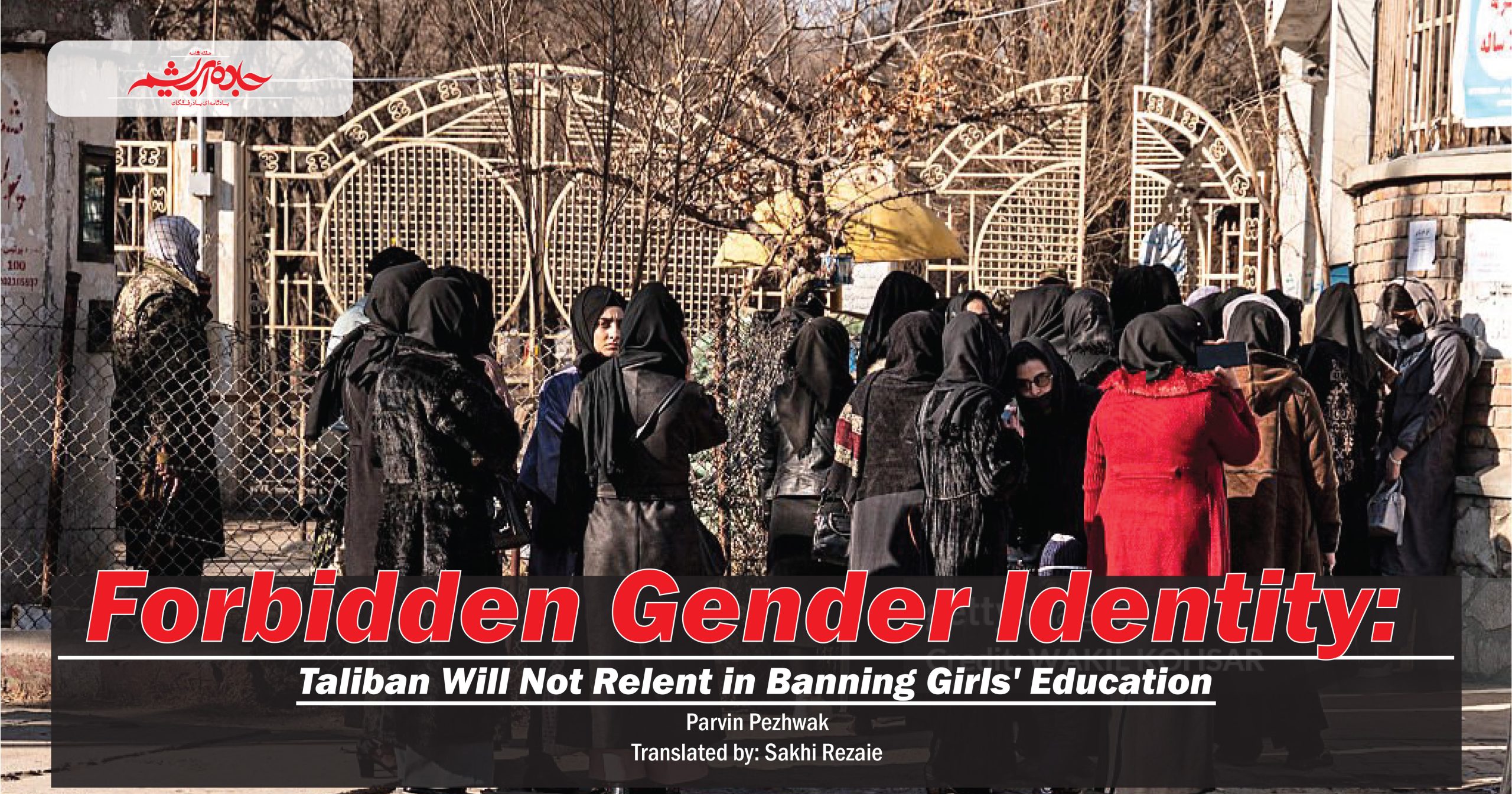
 Parvin Pezhwak
Translated by: Sakhi Rezaie
In the modern and postmodern era, especially the genealogical efforts that Foucault created regarding gender and, more importantly, the egalitarian feminist movements in support of women’s rights and freedom, a new space for women’s action and existence was formed that played a prominent role in shaping the new nature of societies and their transformation. In light of the logic of these transformations, it is no longer possible to turn women back and treat them as objects or confine them in the narrow corridors of life; but this does not mean the negation of crushing limitations. At least the requirements of the contemporary world and the models of struggle in the present era have led women to fight against the confining and restrictive frameworks. From a moral and religious perspective on the status of women and the sum of different narratives and different readings of religion, and considering the contemporary experiences of Islamic countries, it can be said with certainty that the exclusion of women and their exclusion from society, education, economy and politics has no reasonable, legitimate or moral justification. Thus, women’s education is one of the most basic human rights. However, in Afghanistan, with the return of the Taliban to power in 2021, severe restrictions were imposed on women’s lives, including education and work, making conditions difficult for women once again.
This dawn of awareness did not last long before the dreaded Taliban regime emerged from the midst of national conflicts and religious struggles in 1996 and by 2001, it had completely engulfed society under the black umbrella of corruption and darkness. With the Taliban coming to power in 1966, all girls’ schools were closed, women were deprived of the right to education and work, and even boys’ schools in many areas began to close. However, with the re-emergence of the Taliban in 2021, millions of girls were banned from attending secondary schools and universities.
Since the Taliban came to power in August 2021, they have imposed restrictions on girls’ education from the outset. In March 2022, the group closed all-girls secondary schools, and in December 2022, women were banned from universities. Although Islamic religious texts explicitly emphasize the importance and right of women to education, extremist narratives of the religion have led to restrictions on girls’ education. The Taliban claim that educational restrictions are dictated by their interpretation of Islamic law and that the previous form of female education is illegitimate, while many Islamic scholars inside and outside Afghanistan have rejected this claim and have consistently called on the Taliban to reopen schools and universities for girls.
What happened to women in Afghanistan was like a crime or a serial murder of women. The Taliban initially announced on September 12, 2021, that women could attend segregated classrooms and universities with mandatory hijab. But in March 2022, they banned girls from attending secondary school. Girls’ secondary schools were supposed to reopen on March 23, 2022, after months of closure; but the Taliban ordered the schools closed just hours after they opened.
University and the Fourth Year of Girls’ Education Ban
With the start of the new academic year 1404 (2025), this is the fourth consecutive year that girls cannot go to university. Although the Taliban said after regaining power on 15 August, 2021, that they would not prohibit girls from studying; however, with each passing day, they imposed various restrictions on girls and women. In March 2001, Abdul Baqi Haqqani, the acting Taliban Minister of Higher Education, declared during a press conference that mixing girls and boys in the same class “is contrary to Islamic values” and also “contradicts the national, cultural and traditional values of Afghans.”
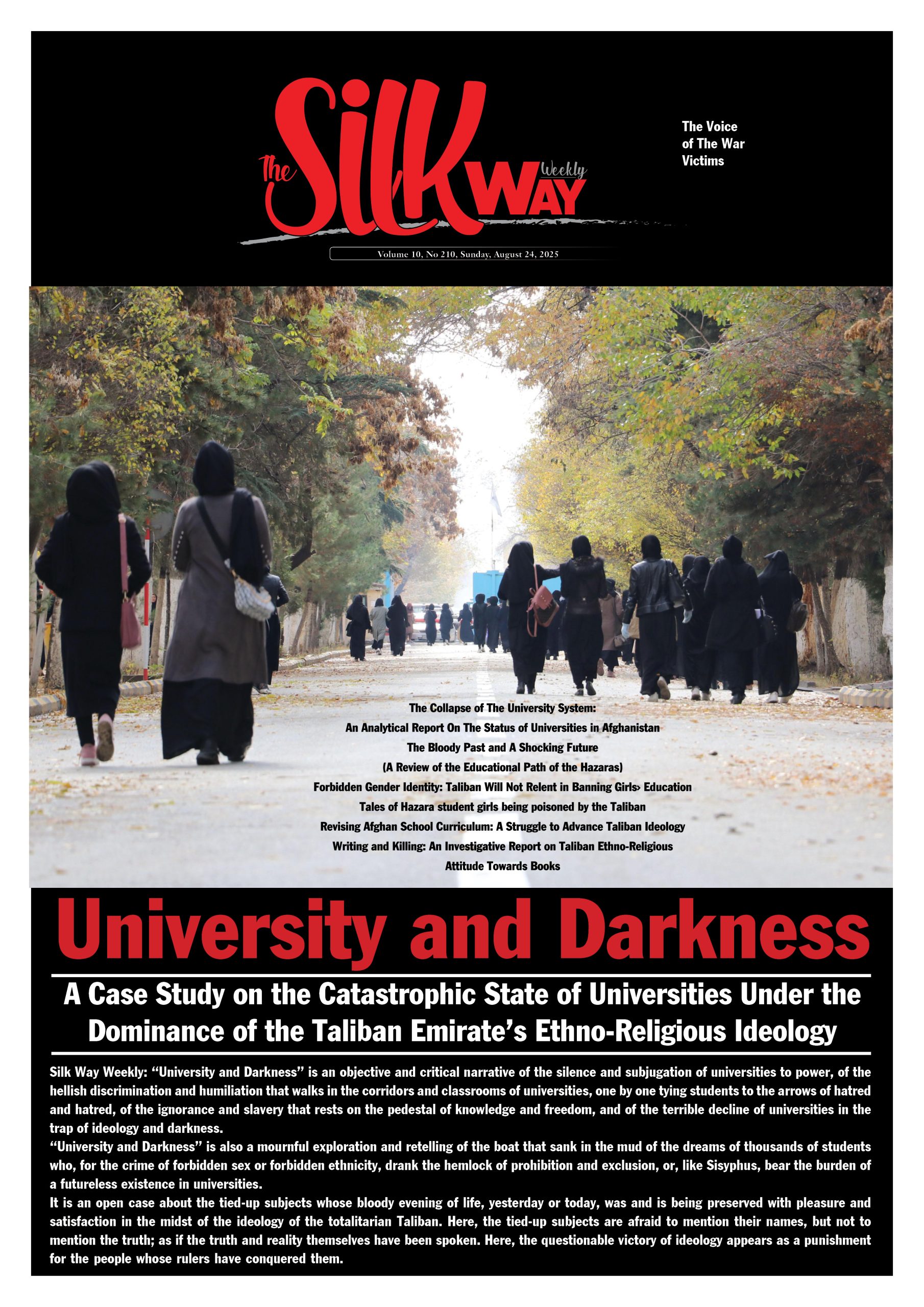
When the Taliban government announced the resumption of university classes at the beginning of 1401 AH, (March 2022), despite the reopening of public universities, the presence of female students in universities was low. Private universities in the country began their courses by separating girls’ and boys’ classes. However, in the month of Saur of the same year, the Taliban ordered that girls and boys come to university three days a week. Based on this decision, three days a week were allocated to female students and the other three days to male students.
 What happened to girls during the separate days and places of study?
When the Taliban Ministry of Higher Education decided in Saur 1401 (April 2022) that male and female students would attend classes at universities on separate days of the week, based on this decision, Saturdays, Mondays, and Wednesdays were allocated to female students and Sundays, Tuesdays, and Thursdays to male students. This time allocation was attached to a notice from the Taliban Ministry of Higher Education sent to universities for implementation. At this time, female students could not go to the offices of male university professors and had to be summoned in public spaces by prior arrangement to raise their problems outside.
Fatemah Alizadah (pseudonym), who graduated from a government university before the Taliban took over and went to complete her university documents in 2022, says: “The day I went to university with my friends, I saw that they had taken away our permission to walk around the university. To the extent that when we had something to do with a professor, we had to call the professor and he would come out to see him. We couldn’t even go without coordination.” The day Fatemah went to her university during the Taliban rule, she was able to feel the pain of the girls who doors were closed to them more than ever. She says: “It gives you a very bad feeling, without having committed a crime, without having committed a sin, you are treated like this. We were not even allowed to walk around the department, let alone go to their offices.” As Fatemah recalls those days, she says: “It was very painful for me that they even blocked our way of passing. It was still good that we were allowed to go inside the university. Now that they have taken that away from us, it is much worse than their previous decision. The moment you are exposed to such treatment, you feel discrimination, prejudice, hatred and gender inequality with all your being.” That day, she had seen the doors of the offices of male professors and female employees separated, and the wandering of the two sexes in the forbidden place had bad consequences. Ruqiya (pseudonym), one of Fatrmah’s friends who went to university with her, also recounts that she was confronted with very strange scenes that were hard for her to believe that day. The girls’ long black dresses and the atmosphere far from joy and life that bothered her. According to her, “When we tried to go inside the library and the department, we really realized that there was no longer a university left, it was almost like a prison rather than a university.” She says that she left that day without being able to do anything to get her documents, and she still remembers how the guard was at the door of the department building to prevent girls from entering, and how the corridors were separated with locks and windows to prevent girls from entering those sections.
Mandatory hijab and student protests
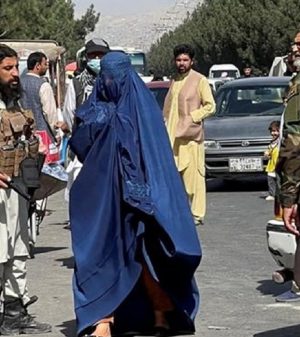
The presence of girls at university in the first days of the ban, with mandatory hijabs and faces covered, in classrooms that were divided in half by a curtain, with girls on one side and boys on the other, was extremely painful and tragic.
In the eve of the reopening of universities, the Taliban issued a statement on 7th May, 2022, that all female students must wear black abayas and burqas and attend single-sex classes. After Taliban prevented a number of female students from entering Badakhshan University, dozens of girls protested in front of the university’s gates. The demonstration began on Sunday morning, November 29, after Taliban prevented them from entering the university on the pretext of “not having burqas.” Sara (pseudonym) studied journalism at Badakhshan University and completed her third year. It was during her fourth year of study that the Taliban ordered the closure of universities to girls. “We had not worn burqas until the Taliban forced girls to wear black burqas,” says Sara. At first, we said we didn’t want to wear the burqa and we wanted to come to the university and study in this attire. But when we read the announcement and went to the university, we saw that the girls had gathered behind the gate.” She had seen a gatekeeper beating the girls at the gate. This gatekeeper had “beaten a girl so much that she fainted.” The girls were making noise behind the gate. The university president also spoke very rudely that day and, addressing the girl who was complaining about this incident, said, “Go away, you whore!” The situation at Badakhshan University that day was tense and girls were not allowed to enter the university. The situation also worsened and a number of girls left the place, and according to Sara, those who stayed were beaten even more. But the girls that day had the will to demand justice and said to each other: “Why are you silent? Let’s at least raise our voices. Someone will definitely hear us.” About fifty female students gathered and chanted slogans such as “Education is our right. Don’t take this right away from us. Don’t close the university gates to us under various pretexts.” They wrote posters and leaflets and chanted slogans on the roads. At one point along the way, a Taliban vehicle came and stopped them and warned them, “Don’t move forward, otherwise it will end badly for you.” They ignored it. When we passed the “University Bridge,” the situation got much worse when we reached the Baktash area. The Taliban came and said, “Go back and don’t move forward. Don’t be more shameless. Don’t make things worse for yourself.” But the girls continued, and when they entered the city, all the people supported them. From drivers to pedestrians to vendors, everyone kept repeating after them, “Education is our right.” According to Sara, “People didn’t react negatively to us at all, and that made us feel good.” When the protesting students of Badakhshan arrived at the Maiwand crossroads, a Taliban ranger approached them. Six Taliban got out, whips in their hands and their faces covered with handkerchiefs, and attacked the girls. By this time, the number of girls had dwindled to about twenty. “They were beating the girls with whips. They attacked brutally. They attacked like wolves.” With this Taliban attack, the girls scattered, and only three of them, including Sara, remained. “There were only three of us left. People wanted to help us, but the situation was so difficult that they couldn’t. Some people were just saying, ‘Don’t hit the girls,’ but no one could come forward.” Eventually, the group was suppressed by the Taliban and dispersed, and the girls couldn’t move any further. According to Sar, if they had stayed, they would have been injured. Sara says that after the Taliban ranger left the place and after the girls dispersed, another Taliban car followed her. She went to a relative’s house so that her house wouldn’t be exposed. She went from alley to alley, from street to street. That night and the next day, she didn’t leave the house. Sara tells us: “I felt very bad afterwards. “When I wanted to go out, I felt like I was being followed and someone was following me and kidnapping me. I still have this feeling, but somehow we got used to it, but I’m still afraid. We didn’t ask for anything but our rights in this lawsuit. I still feel the whips that were applied to my shoulders, face, and back, I still get hurt, but we are strong women and we will continue.”
Girls not allowed taking pictures on the campus grounds
Continuing the restrictions, the Taliban in September 2012 ordered female students in the midwifery department of Kabul Medical University to refrain from taking photos and filming on the university grounds. The Taliban had said that girls should “separately” refrain from taking photos and filming, calling the act a “grave sin” under Islamic law. The order was signed by Eng. Azimullah Kamran, the vice president for finance and administration at Kabul Medical University, and stated that the order should be communicated to all students at the university. The Taliban had previously banned all students at Balkh and Kabul universities from having smartphones.
Girls’ Education and the Taliban’s Atomic Bomb
The Taliban appeared so firm in their original decision that Mohammad Nadeem, the head of Taliban higher education, said on the 26th of December, 2022: “Even if they drop an atomic bomb on us, we will not back down from our decision to ban women from university education.”
The Taliban suspended the education of girls and women in private and public universities in Afghanistan in December 2022. At the time, Nida Mohammad Nadeem, the Taliban’s Minister of Higher Education, said the ban was necessary to prevent girls and boys from mixing in universities and because some of the subjects taught violated Islamic principles. The Taliban said it was temporary and that universities would reopen to girls, but then, in February 2022, they banned women from taking the university entrance exam. A Taliban spokesman announced in a message to private universities that women had been banned from taking the entrance exam. He had said in a television interview that work was underway to resolve these problems and that after these issues were resolved, universities would be opened to women; a promise that not only failed to materialize, but has continued to this day, more than two years later, as in September 2024, Nada Mohammad Nadeem, the Taliban’s Minister of Higher Education, told reporters in a press conference in Kabul that asking about girls’ education was postponed until further notice. He had said: “The short answer to this issue is that just as education is postponed until further notice, the question (about them) is also postponed until further notice.”
Female professors and female administrative staff at the university
After the restrictions were announced and imposed on female students, they were also imposed on female professors and employees at universities without exception. These restrictions included mandatory hijab, restrictions on the color and type of clothing, restrictions on the choice of major, separate days and separate classes, and other restrictions. With the ban on girls from universities, female professors and university administrative employees were also banned from attending universities and now receive only five thousand Afghanis per month.
Before the Taliban, women held various levels of management and education. People like Lailoma Sharifinia, who was the president of the University of Education and Training. She taught at the university for more than thirty years and became the president of Kabul University of Education and Training in 2020, and served as the president until September 2023. When girls were banned from the university, she remained the president of the university but continued to work from home online; however, she did not receive a salary from the president. In the month of Jan 2022, when girls’ classes were stopped, she worked from home for another nine months. “It was hard for the university and for me,” she says. The Taliban had told her that she could choose to leave or continue working; but since she no longer had direct control over her work and was not receiving a salary, she was forced to leave her job.
There were also many women working in private universities who, after the ban on their work, became housewives and did not receive the same five thousand salary as professors at public universities. Sakhi Akrami (pseudonym), who is now an administrative employee at a private university in Barchi, Kabul, says that before she worked at this university, many women had been employed there and resigned from their jobs after the Taliban issued orders that put these women in hardship. According to Akrami: “After the Taliban imposed the ban on women, the university waited for the next order stating that this ban might be lifted; but it did not happen. So the female employees voluntarily resigned and settled their accounts.”
On December 20, 2022, the Taliban sent a letter to a private university stating that girls could no longer attend the university and that female professors could no longer continue teaching at public and private universities. With this, the work of Ms. Farzaneh Sharif and other female professors at the university was suspended. Ms. Sharif, a university professor who has taught literature at various private universities for about eleven years, says that the day the Taliban sent this letter to the university where she taught was the last day of her students’ exams; but she was unable to take her students’ exams as instructed in the letter. She says that the girls were crying and did not know what to do and did not know when they would be able to continue their studies again.
That day, Professor Farzaneh Sharif and her colleagues had the worst experience of their lives and were no longer able to work. She adds: “From that day on, all the girls called and cried, asking what to do, Professor.” Ms. Sharif then decided to teach her subject online and for free. She continued to teach these online classes on a regular basis for several months. According to Ms. Sharif, when girls were banned from university, a number of her students scattered to Iran and Pakistan, while others were forced into marriage, and this situation was painful for her.
With the Taliban’s restrictive decrees, many female professors, including Ms. Sharif, left the country and chose to emigrate rather than stay. Ms. Nesa Mohammadi, a professor and former university president who emigrated before the Taliban entered Kabul, says that many of her colleagues in Kabul were forced to leave their country for Iran and Pakistan after the restrictions on women’s education were imposed.
The Closure of Universities and Its Consequences on Girls’ Lives
With girls banned from universities, most girls stayed home, some turned to jobs such as tailoring and sewing, and others found their last hope, educational centers; but a large number of women and girls suffered from mental illnesses due to lack of jobs and income and incomplete education.
Zainab is one of the girls who has suffered from a serious mental health problem. She managed to enter university in 2021 after enduring many hardships, and when she was in her second semester of university, she heard rumors that universities would be closed to girls. “We were halfway through the second semester when we heard news from all over the place that some courses were being closed or restrictions were being imposed. After three months of the second semester, we were on the alert every day that our university would be closed too. One day, this unfortunate event finally happened and the universities were closed.” Zainab was very disappointed and could not believe that her university had been closed. She was waiting for the situation to allow her to go to university again. Zainab says that the day the order to close universities to girls was issued, all their professors were standing in the university courtyard watching the moment they left the university, and some of them were crying.
Zeinab says that after that, I remained undecided for a long time and “I couldn’t believe that all the goals, dreams, and plans I had were thwarted and all the doors were closed to me. I was very damaged mentally and emotionally, because whenever the name of the university was mentioned, I would cry uncontrollably and I couldn’t help myself. I was at home all this time, I didn’t want to go out; except that my family forced me to take language courses and study English.”
Basira Ramoz is a girl who studied engineering before the Taliban came to power again, but was not allowed to work because of her gender. She participated in an internship during her studies. When her internship was over, she was told to go to work after graduation. “But three months later, the Taliban came and when I went to the office, they only gave me a certificate for the internship; but they did not let us girls do the work because the boss became a Taliban member.”
Basira later tries to get a job at a private company affiliated with the water supply department. So she applies for a job at this company. But she is told, “Women are not allowed to work.” She says, “Unfortunately, I have not worked in my field at all, and now I have been a housewife for nearly four years.”
By restricting girls from continuing their education, the Taliban have robbed thousands of girls and women of their dreams. Many girls have not completed their bachelor’s degrees, and others who had completed their bachelor’s degrees before the Taliban, after the Taliban came abandoned their higher education. Sakina (pseudonym) is one of these girls. She says, “I cannot study abroad due to family problems. I hope that one day girls can continue their education and I can continue my education.”
The Taliban were terrified of their future, and they saw no choice but to close universities and oppress girls in an unmanly way, and they did so. This means that universities could have been the center of protest movements against the Taliban and their oppressive system, but the Taliban took steps to close them down in advance.

Add Comment