





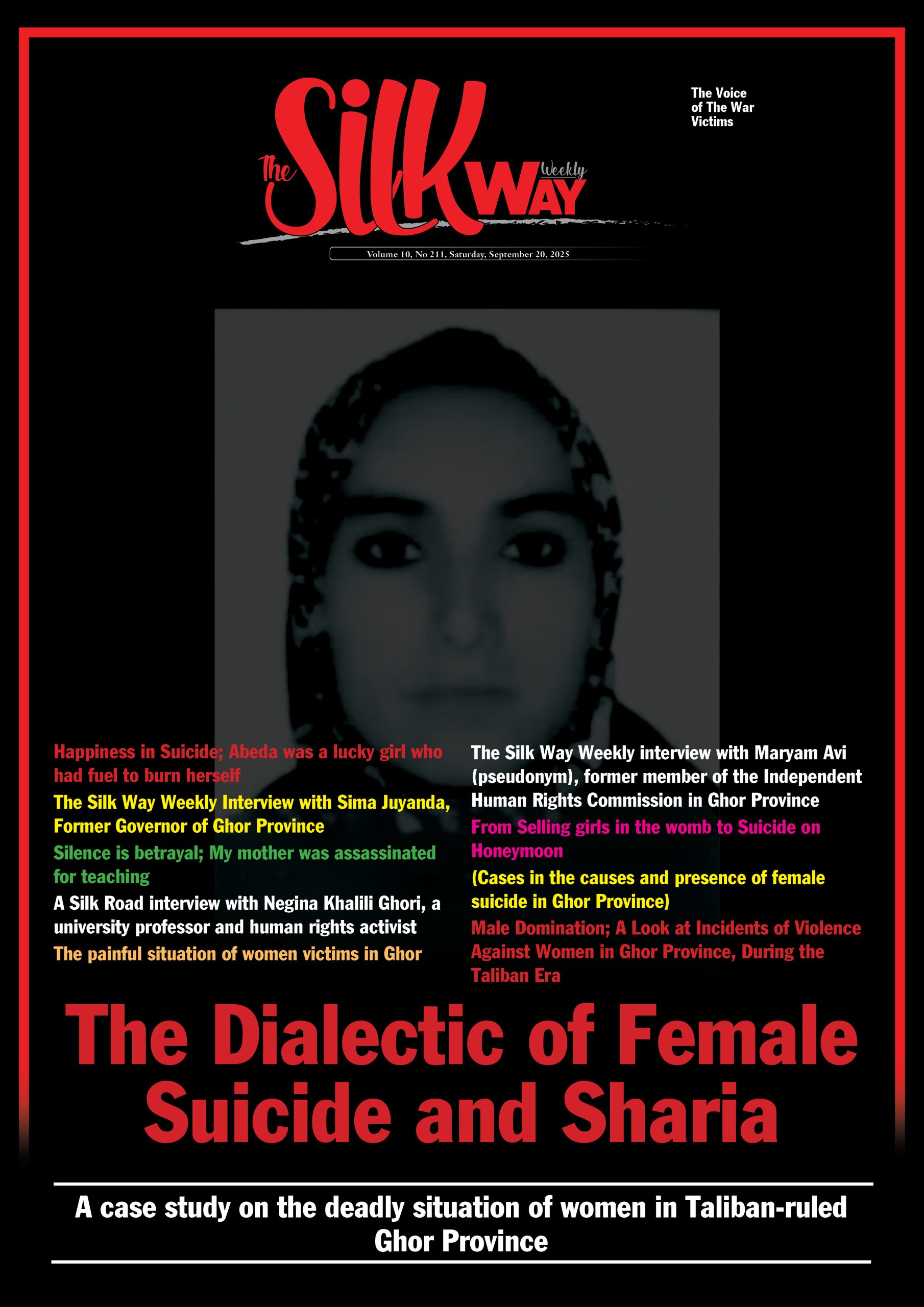
A case study on the deadly situation of women in Taliban-ruled Ghor Province
Dr. Roohullah Kazemi
 Note: Download the English version PDF here.
Abeda, this is not a name but a soul on fire, not a narrative but a living and direct question on the coffin of collective wisdom that rests on the shoulders of patriarchy and tribal instincts. She, who rushed to welcome the flames of liberation, became a myth and a symbol in the eyes of the girls of Ghor that will forever remain as a void in collective wisdom and a crack in the general humanity of society; the myth of “negative happiness” that walked through self-destructive violence as a metaphor for collective death. Happiness in Ghor is defined as a suicide farm and the auction of women’s existence, not in living but in choosing a form of death that exposes public indifference as a lack of understanding and inability to understand humanity. Abeda, as if she were “fortunate”, other women and girls also saw and interpreted her in the context of their existence; because under the beating of fathers as masters, she did not stain her face with acid; the rope of her brothers’ inheritance did not cut her frail neck, she did not enter the chest of consecrated old men whose sanctity was not tested by any human order or logic, and not a particle of the radiation of the sun of honor and human conscience penetrated or crept into the dark dungeon of their bad conscience. This is not sinister happiness; it is glorious and beyond the level of existence defined in the dictionary of patriarchy. The choice between sacrosanct aggression and the reckless choice of self-immolation with gasoline is the true dialectic of life and death, the radical transformation of the molds followed, a new definition of life and death, and the ultimate freedom possible in the realm of backwardness.
Creativity in death is a kind of writing of death; it is not the writing of destruction, but the transformation of death into a tool for life and its definition. When the truth so cold and novel seizes the sphere of reality, death itself must be manipulated; not as the end of life, but the beginning of life, which is why many even saw this “self-immolation” as a privilege; as a luxury of liberation. The closed society of Ghor, under the rule of the Taliban, has become a factory for the production of dirty desires for dirty men who do not only target the bodies of women and girls, but also their souls and human honor. Women do not burn in the dream of home, love or children, but in the fever of finding the hanging rope, the destructive pills and the liberating flames. Death emerges here as the final realm of “choice,” a choice that, from the perspective of the reactionary structure, is considered the happiness and identity of men.
 Thus, Ghor is the dark laboratory of “tribal identity”; in the sense that patriarchy as a chronic disease, with its contaminated link to the hegemonic desires of the Taliban, has perfected the logic of profit and loss of the female body, in such a way that even the negation of the unity of women no longer makes sense on the grave of the honor and human identity of women/girls; it makes sense on the suspension of humanity in general. This is precisely why women are “engaged” even in the embryo, that is, if there is no body yet, her mere name must give sexual pleasure to men; a sexual debt that begins even before birth.
In tribal tradition and now in the embrace of Taliban traditions, women are not only a commodity in the market of lust; they are also sold as blood money to grudges, handed over to the husband’s brothers as a “sexual inheritance”. A woman is not destroyed by stoning; because even her negation is not an issue; her negation is an issue only for herself; the stoning of a woman is in fact the glorious setting up of the “sacred theater of Sharia”; because in Sharia, such a role has been defined in advance for her. Rukhshana is actually an actor in the setting up of Sharia Theater; at the very moment when half of her body is swallowed by dust and stones are thrown at her. Although Rukhshana is not considered a human being when she is stoned; but her death brings Sharia to salvation and Sharia is established. Her death is the life of Sharia. When the stones of tradition, with hatred, bruise her entire body and slowly take her life, only then does her tribe and her Sharia attain an indescribable beauty. The presence of the Sima Juyanad as a female governor in a tribal and patriarchal culture, is never interpreted as her service and human elevation, but rather as a violation of male dominance and sanctity.
The forms of women’s death also have another fundamental dimension: death as language. Now that under the iron umbrella of the Taliban, violence has become more systematic and silence and speechlessness have become thicker and more terrifying, death and silence can be the only radical language against this situation. Even where it is apparently believed that there is no death and silence; death and silence must be present more sadly than anywhere else.
The Silk Way case is the struggle of the forests that have hidden death and silence. This is an effort of resistance against the industry of death under the banner of Taliban rule, but as Adorno said: “The reflection of suffering in art always carries the risk of beautifying suffering”; therefore, the narrative must be presented as a “document of crime”, not a “sad story”, the Silk Way also presents documents of crime.

Add Comment