





Hafiz
Translated by Sakhi Rezaie
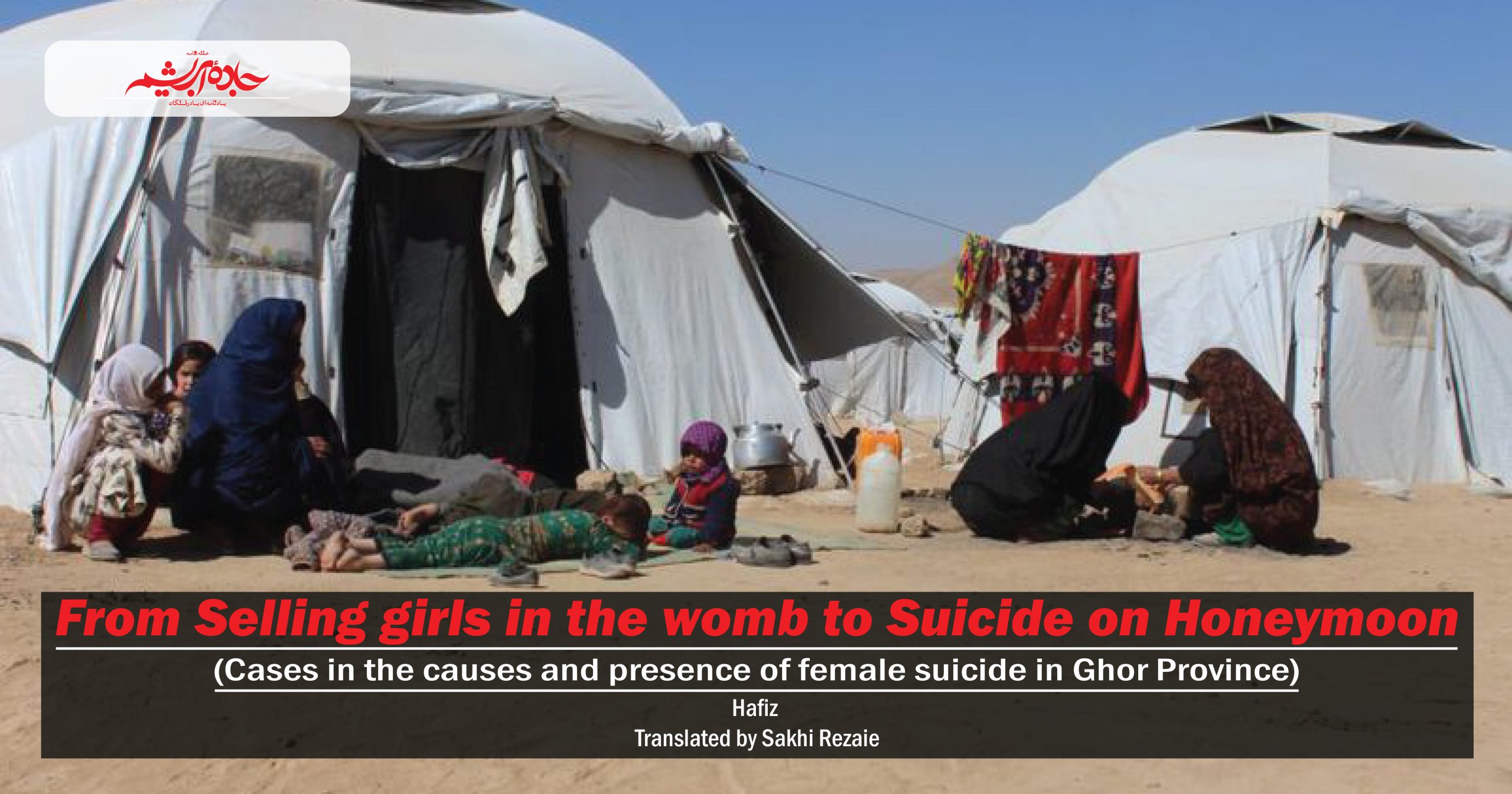 Based on statistics and figures of suicide, self-immolation, stoning and flogging of women in Ghor province of Afghanistan, this province has been one of the worst provinces in Afghanistan for women for many years. Female suicide in Ghor has a long history. Even during the republican era, there was space for Taliban’s women suppressing policies in most districts of Ghor province. Almost throughout the republican era, flogging and stoning of women continued in Ghor.
In October 2015, Rokhshaneh, a teenage girl, was stoned to death in Ghor. According to a report by Zahra Nader and Mujeeb Mashal in the New York Times and translated by the newspaper Etelaat-e-Rooz on July 10, 2017, local gunmen—who were then the Taliban government—buried Rokhshaneh in the ground up to her waist and then stoned her to death. According to the report, Rokhshaneh’s mother said, “From the waist up, the stones tore her body apart, and pieces of the stone were lodged in her ribs.”
In the same years, the number of female suicides in Ghor province was also high. Two and a half years before the fall of the country to the Taliban, on (June 8, 2018), Mozhgan, a 17-year-old girl, committed suicide in the Saghar district of Ghor province. This was not the first or last suicide of women in the province. Before and after that, many women and girls committed suicide in other districts of the province, from Chaharsada to Saghar, and from Teyawara to Markaz.
Similarly, even during the republican years, women in Ghor province were repeatedly stoned and flogged.
Zarmina, a young woman, was flogged in public in 2015. Chamangol, a 20-year-old woman, was shot dead on the way from Chaharsadah district of Ghor province to Lolash district of Faryab province.
After the fall of the country and under Taliban rule, the situation for women in Ghor has undoubtedly worsened. In addition to the forced relocation of women, which has had many consequences, including poverty, depression, and endless longing, and has so far caused many women and girls to commit suicide, the Taliban’s polygamy and forced marriages have also caused the deaths of many women. In the latest case, on (April 27, 2025), Abida, a 20-year-old girl from the village of “Darzab Nili” in the Teyawara district of Ghor province, set herself on fire to escape a forced marriage to a local Taliban commander.
This article discusses the causes and factors of women’s suicide in Ghor Province. For some readers, the issue is clear. They have lived in this society, and for years they have seen with their own eyes what has become a women’s gallows circle. What has taken women’s lives. What has driven brides to commit suicide even on their honeymoon. But for others, who, in the words of José Saramago, suffer from “white blindness” and do not see the tragedy with their eyes open among countless white and sacred cases, we have once again mentioned that some of the most important and worst cases of women’s suicide did not come from outside, but are rooted in this society, in our relationships, in our religion and customs, and in ourselves and our families. Let us briefly remind them that “what is from us is upon us.”
Pleasure for old men, death for young girls – a culture of polygamy
For many years, one of the main reasons for female suicide in Ghor Province (and throughout Afghanistan) has been the polygamy of older men. Many older men, who have either been accustomed to multiple relationships since their youth or have been deprived of love and friendship due to the restrictions prevailing in society, have turned to pleasure in old age to compensate or out of habit.
There have been many cases where men over fifty years of age, who have had several wives at the same time, have still proposed to underage girls. These village elders, who have both influence, status and power, and in most cases the mullah and the school have also been on their side, have put pressure on the girls and their families and threatened them. They have even practically put pressure on the girls and their families, and in many cases, these pressures and threats and insistence of the old men for forced marriage have caused young girls to commit suicide.
This phenomenon increased during the Taliban era. According to reports published in the media, including a report by the human rights organization “Tolerance”, child marriage increased during the Taliban era. In a report by the human rights organization “Tolerance”, published on the occasion of the second anniversary of the Taliban’s rule on the occasion of Children’s Day, it is stated that local Taliban commanders take advantage of the poverty and helplessness of the people and forcefully marry underage girls to themselves. These forced marriages are also one of the reasons for women’s suicide in Ghor province. Sources from Ghor province told the Silk Way Weekly that in the Pushtanoor region of Ghor province, a girl of about nine to ten years old was forcibly married by a Taliban of about sixty years old. According to the sources, after the marriage, the girl was injured in forced intercourse with a man who was several times older than her and was taken to the hospital. At the hospital, according to the diagnosis of doctors, the girl’s womb was gone and was pulled out by the same doctors.
Premature birth, suicide on honeymoon – escape from sin and religious factor
One of the things that has made life harder and harder for women and girls over the years is the indulgence and drinking that is covered up with religious deception. From mosques and local mullahs to the general public, there is a category that says that women should marry as soon as possible to avoid sin. Polygamy of men is also justified with similar categories. They say that men should take three or four wives so that they do not fall into sin and do not have their eyes fixed on anyone.
This category has come from the realm of religion and Sharia and entered the realm of culture, customs, and the daily lives of people. But it has created disastrous margins. In places, especially in closed societies where mullahs and sacred matters have reigned supreme, its scope has become so broad that sometimes the general public measures daily life matters by it.
The ever-widening spread of such categories has made the space for women’s lives increasingly narrow. Especially where women are involved, there has been a completely inverse relationship between the spread of some religious categories and women’s lives. To the extent that religious extremism has become more widespread, women’s space has become narrower and narrower. Based on religious justifications, a man who should have one wife has taken four wives. In a house where there should be one woman, there have sometimes been four women. In love and relationships where there should be one person, there have sometimes been several women.
Similarly, a girl who must become an adult and decide for herself who she will marry and live with is married to a man when she is just an infant by her family and close circle of relatives, based on the religion and culture of the local people.
In the Sharia as a believer, in the human rights as a savage
In order to avoid sin, sometimes girls are given to husbands before they reach adulthood. It has even been common for many years and is still common in places to name girls in their embryos and before they are born. It is still unknown whether the girl will be born alive or not, in what form and appearance she will be born, it is not known whether the boy who is to be born is healthy or not, what his form and appearance will be, and during the eighteen or nineteen years that they have to wait until they reach adulthood and get married, whether they will accept each other or not. However, these demands are not important at all for a large number of Afghan people, especially some of the people of Ghor. As soon as a father, or a mullah, or a local influential person, based on local beliefs and culture, decides to engage a girl in her embryo, they do so. There is no question, no criticism, no breaking of the mold.
Several local sources from Ghor province told Silk Way Weekly that in many districts of the province, including Pushtanoor, Samak, Murghab, Teyawara, Tulak and other areas of the province, girls are engaged when they are in their embryo. According to the sources, the locals call the engagement in embryo “namgoya” and in some places “chanaq”, which is the same as gambling.
Sources add that pregnant women cannot go to the doctor to have their sperm tested to find out whether the unborn child is a boy or a girl. Only men call them by each other’s names and say that if it is a girl, she is my bride and if it is a boy, she is my son-in-law.
This behavior has existed for many years. This oppression and oppression of women was originally an escape from sin and religious work, and later it gradually became part of the daily life, customs and traditions and part of the local culture of the people. In such societies, there was no literacy, no rebellion, and no criticism. People were completely obedient to the dictates of religious extremism, and later the next generation was obedient to the dictates of the previous generation. Society was completely absorbed in the patriarchal structure, and this oppression, with a religious and cultural color, has been proudly spread and continued, according to the local people’s imagination, and is still considered a strong and important structure and one of the things that ends in honor and dignity.
Many pious men, especially influential white beard men, feel proud of this child marriage and naming girls in the womb. They are proud that they have fulfilled their religious duty and are keeping society clean from sin and pollution. Years later, when the unborn babies grow up, gain intelligence and sense, and do not want each other, it usually costs the girls dearly.
A source from Murghab district of Ghor province told the Silk Way Weekly that years ago, the fathers of two families married off their newborns to each other. After seventeen or eighteen years, the newborns have now grown up and one of the girls is not happy with the forced marriage. According to the source, the girl has told her father’s family and her fiancé’s family that she does not want the boy and does not consent to the marriage; but if her brother wants her fiancé to live with him, she has nothing to do with them.
But the families are not listening. They say they were betrothed as children and have no right to marry anyone else. The source says that there was no understanding between them and the matter has escalated into armed conflict.
Among many factors, this same unborn child in the womb and the newborn has repeatedly caused young girls to commit suicide on their honeymoon, and the local devout and influential men once again accuse the girl who committed suicide of shamelessness, irreligiousness, and rebellion against religion and the customs of the society, and bury the young bodies of the girls with shame and disgrace. The girls’ desire and suicide either remain completely silent and no one talks about it out of shame and disgrace, or once again, the men of the society see the dishonor of women falling from the roof and once again women are accused of rebellion and the place becomes narrower for them. Once again, in Hafez’s words, “this tribe will receive compensation from the dead.”
This society and this behavior, however, to the extent that they are considered religious to the local people, are considered completely barbaric, cruel, oppressive, and inhuman from a human perspective and in terms of human rights. For years, they did not let the voice of justice and equality reach the ears of the local people. But if they had let human rights speak out, those extremist men who were considered religiously pious by their actions would have been considered very clearly “barbaric” in terms of human rights.
“Give a girl, got a cow” – Economic factor
Another factor in the suicide and self-immolation of women in Ghor is the buying and selling of women. The financial situation of the people in Ghor is dire. Both due to political isolation and the inattention of the governments and due to its dry and harsh nature, the level of the people’s economy has remained low. The general population of Ghor province is penniless and poor.
This situation has had dangerous consequences for women. Almost more than 90 percent of brides in Ghor province have been sold. It was either an exchange or a deal. In the exchange, families have given and taken a daughter. They have given their daughters to the husband, and in return, they have brought a daughter from the groom’s family for their son. In the deal, however, they have given the daughter and received goods and money.
Since cash was scarce in poor communities, including in Ghor, families exchanged cows, goats, donkeys, sheep, wheat, clothes, oil, tea, sugar, trees, land, and houses for girls instead of cash.
“The girl paid the price in blood”
But sometimes, in even more tragic cases, young girls were also given as blood money. There are many cases where there has been conflict between two tribes and two families. In a war between men, a person has been killed. In order for one side to pay blood money and for the blood to be cleansed by the people’s decision and the local mullah’s fatwa, and for hatred and bitterness to be removed and for an enemy to turn into a friend, a girl was given as the blood money for the victim. In that dark and fearful night, the girls seemed to be the “tree of friendship” that was expected to bear fruit. Forced, two fathers were in the same bed, and the woman felt guilty and blamed every moment.
But based on the evidence available, in most cases, these transactions have not only not reduced the resentment and bitterness, but have also placed the brides squarely in the middle of the enemy family. After years of listening to each other, bargaining, and fighting in the house, the forest is finally on fire and the girls are forced to commit suicide in a house they do not know is the house of their love and future or the house of enmity and patricide. A local source from Ghor province told the Silk Way Weekly that in most districts of the province, the custom of giving away girls for blood money is still prevalent.
The source, who asked not to be named, said that, among other things, his own aunt was given a blood price. The story goes that a man was hunting in Dawlatyar district of Ghor province. The hunt was far away and undetectable. The man shot at the prey and the bullet hit a woman. The woman was also pregnant.
After the woman was killed, her family, after identifying the killer, demanded blood price from the hunter. The killer’s family had seven daughters. Those areas were not under government control and the village chief made the decision. The chief decided that the blood price for the pregnant woman would be seven daughters who were in the hunter’s house.
The people of the village and the killer’s family apologize and beg, and the lord reduces two of the seven daughters and decides to give five daughters as a ransom. Again, after the pleading of relatives and friends, two of the seven daughters that the lord had appointed as a ransom were given to that family, including one who is the aunt of the same source who spoke to us.
It is true that over the years, some of the female suicides have been rooted in economic factors, but in all these years, selling women has not improved the economy. Even in the age of artificial intelligence, a group of men in society sell their daughters in order to become specialists, study, and learn a profession due to the changing economic situation. After many years, some people still do not let the women in their families go to work with their own enthusiasm and freedom, earn an income, and have a home and capital of their own. Economically, all the hope of these families is only fixed on the cow that is obtained from selling their daughters. Such solutions are reminiscent of the story that once a blind community walked in the rain with its mouth open instead of finding a well and a spring.
Although the Taliban regime currently prohibits women from working and going out every day under various pretexts, women staying at home is not the only oppression of the Taliban era and the only desire of the Taliban. Aside from the Taliban’s politics and culture, some people cannot tolerate their daughters having shops, markets, cars, and freedom. They can marry at their own will, dress as they please, travel as they please, choose a job at their own discretion, choose a path at their own discretion, and finally live on their own terms.
These injustices, which have become natural and normal because they have been repeated for years and still do not raise any questions, have silently driven women to the brink of suicide and have become one of the main factors in female suicide. Currently, a group of women, after being sold for men’s stomachs, after enduring years of torture and mistreatment by the men of the family, commit suicide at the end of the day hungry.
Gender Discrimination – Derogatory View of Women
One of the reasons for mistreatment of women, which is also a major factor in women’s suicide, is gender discrimination. There is a proverb that is on every man’s lips in villages and towns. They say, “Women are the left’s scapegoat.” In Muslim beliefs, the left has always been hated. When a woman is considered the left’s scapegoat, in the common people’s understanding, it means that she is ugly, inferior, incomplete, and insignificant.
Proverbs are the lifeblood and the culmination of long and complex stories of societies. With just one proverb and its like, they prevent years of responding to oppression. Men in misogynistic societies briefly declare, “We are tired of questions and ashamed of answers.” There is no question, no criticism, no thought. That is how it is. Women are like that and there is no way to do anything to them. They say that women are weak, evil, and a source of shame. There are even cases where husbands have divorced their wives because they gave birth to daughters.
Gender discrimination has always existed and still exists in most parts of Ghor province. Even in Lal Wasar Jangal district, which has more educated people than other districts in Ghor and where women enjoy greater equality and freedom, discrimination has always existed and still exists.
From inheritance to divorce, the power is entirely in the hands of men. Sometimes a woman is not even allowed to buy or sell a goat in her entire life. Although the burden of family life and work falls on women’s shoulders throughout their lives, many women still do not have the power to choose a name for their last child.
Men look down on them. From verbal abuse (from sarcasm and metaphors and proverbs to nicknames) to physical beatings, there is everything. Now that the Taliban have even banned women from going out, but even during the republican era, many things for women were at least socially reprehensible.
For example, throughout the years of the Republic, in Sarjangal Miana (the market squares and the Sefidab school), women and girls were not allowed to play football. They were not singers. There was no art school for women. Even in lectures and religious ceremonies, women did not give speeches or sing hymns.
According to sources told the Silk Way Weekly, there was no school for girls in Murghab district of Ghor province even during the republican government. “All these years, we witnessed that there were no schools for girls in Murghab and some other areas of this province. No girls were studying in some villages. Still, in some villages, there are no literate girls, not even girls who can read a letter.”
Similarly, according to sources, in many parts of the province, girls have no decision-making rights. “In the Murghab, Samak, and Pushtanoor areas, girls have no decision-making rights. There, girls are not even allowed to talk to their uncle’s sons, their maternal cousin’s sons, or their aunt’s sons.”
In those areas and other areas of the Ghor province inhabited by the Aymaks, girls are not allowed by their families to wear makeup. Even if the men in the family are nothing and are in Iran or other countries, those men will still give orders from afar about what their women should buy and wear, whether they should not paint their nails, wear makeup, or even wear new clothes. According to sources, these strictures and gender discrimination have repeatedly been the cause of women’s suicides in those areas.
One of the main reasons for women’s absence from these activities was the social ugliness of women’s activities. In the eyes of the local men, women’s social activities were ugly. Because women are women – that is, because there was gender discrimination in society – they should not do many things. In the eyes of men, women should not bite off more than they can chew. They stayed within their own boundaries, even if that boundary was completely deprivation of any right.
Gender discrimination is one of the main causes of inequality. In some families, the brother has the right to travel, the sister does not. The boy has the right to love and be in love, the girl does not. The boy has the right to do business, the girl does not. If a boy rides a motorcycle, if he rides a bicycle, well, if a girl rides, it is ugly.
Restrictions resulting from gender discrimination have imposed great deprivation on women. Sometimes women have reached the end of these deprivations and committed suicide. But society calls the cause of these suicides a mental problem.
Marriage to Brother’s Wife as an Inheritance
In many areas of Ghor Province, after the death of the husband, the wife is given to relatives, including the husband’s brother, as an inheritance.
There are many examples where after the death of the husband, the husband’s brother has married his brother’s widow without the consent of her. The deceased husband’s brother claims inheritance from his brother and says that, among other things, his brother’s wife should marry him.
In areas near the center of Ghor Province, this story is still prevalent. A source from Dawlatyar told the Silk Road Weekly that in the third year of Taliban rule in Dawlatyar District of this province, a woman was forced to marry her in-laws after her husband’s death. Her brother-in-law claimed that his brother’s wife was his inheritance.
No Crow is Spotless
A young girl, who requested anonymity, from Dawlatyar district of Ghor province, told the Silk Way Weekly that in her short life, she has personally witnessed at least three generations of victims from her family alone: her grandmother, mother, and sister. “Even if we go back and forth, at least as far as I can remember, in front of my eyes, at least three generations of our family alone have been victims. Of course, we have been victims all over. Back and forth. But I personally witnessed these three generations. My mother’s life story is so tragic that I can’t even recount parts of it over the phone. In short, my mother was forcibly given to a husband when she was a child, her husband forcibly took another woman, and he forcibly took her two children from her. Of the two children he took from my mother, one was a girl. “After my mother, that girl was also given to a husband when she was a child. Because she was young and did not yet understand some of the issues of life, her husband took a second wife. Now my maternal sister, who was forcibly separated from her mother and forcibly given to a child wife, is also forcibly the second wife of an old man.”
The source says that it is not only in their family, but this is an example. In every family, there are stories like this. These are not exceptions to a clear situation, it is a general darkness. It is the rule itself. In every home, and almost every woman has been victimized without her own choice, by the coercion of her family. Born unwillingly and under the pressure of her father and brother and male tradition, she has been forbidden love, deprived of children, and her hair has turned white.
Different stories, similar pains
Leo Tolstoy has a line at the beginning of his novel Anna Karenina that has been quoted many times since its publication. He writes, “Happy families are all alike, but unhappy families each have their own story.”
In Afghanistan, where there is a lot of misery and women are more miserable, sometimes every suicide of a woman has its own story. One committed suicide to escape rape. One committed suicide because of betrayal and an old man’s second wife. One committed suicide because of selling her daughter. One committed suicide because she was constantly humiliated and beaten. One committed suicide because she never had any control. One committed suicide because everyone saw her as guilty. One had to flee from the abuse of local strongmen and had no other way or reference to turn to, and committed suicide. One was not allowed to study, so she committed suicide. One was given a blood price and could not bear it and committed suicide in the enemy’s house. One was sold and the money dispute had not yet ended, so she committed suicide. Similarly, every suicide has a story.
But all these different stories return to the same pain: the undisputed rule of men and the suicide and self-immolation of women.
Add Comment