





 By :Roohullah kazemi
Translated by: Sakhi Rezaie
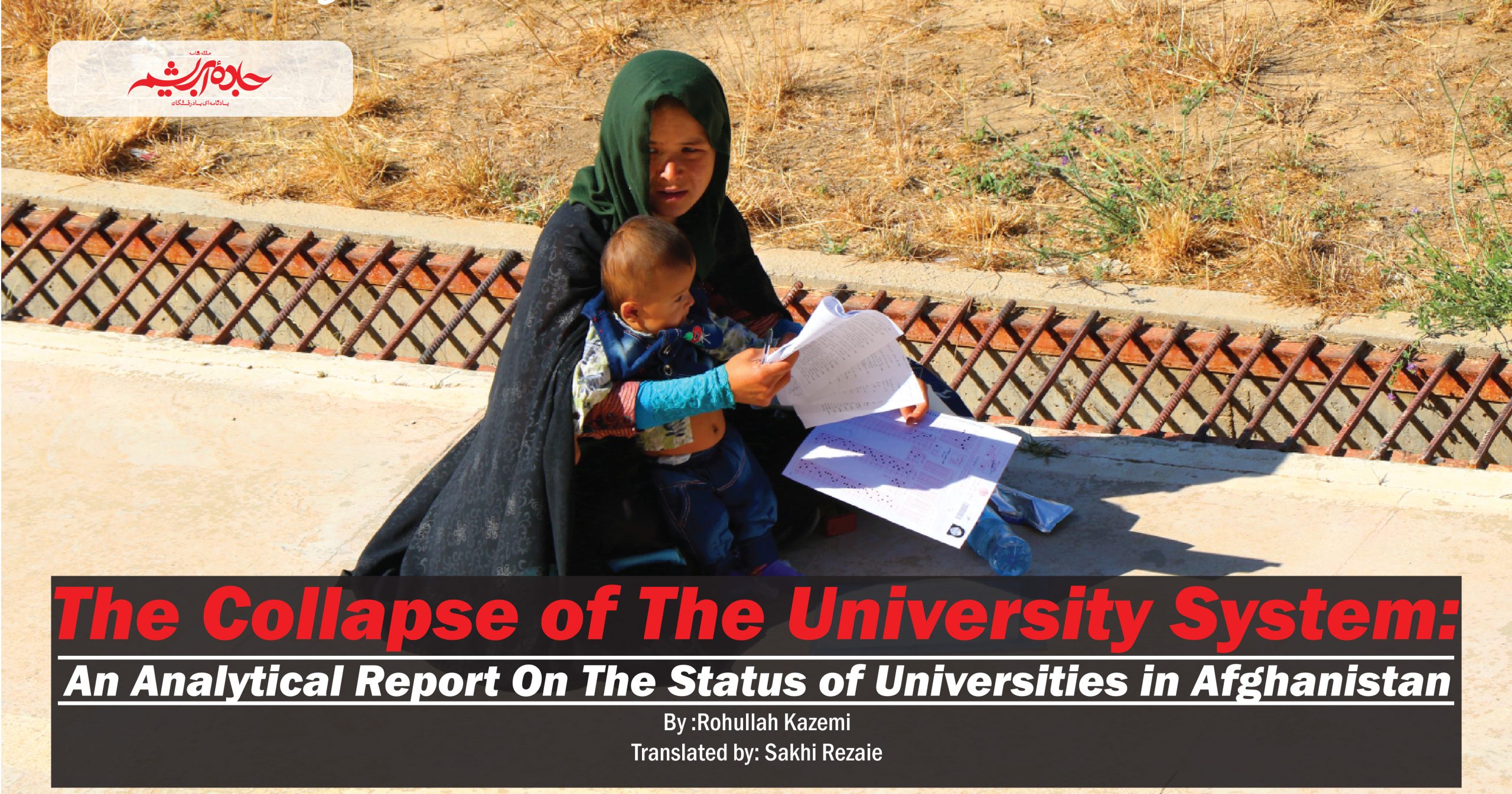
Immediately after the collapse of the political system in Afghanistan and the unfeigned but blind domination of racial hegemony in a new and different guise, the university, as the most prominent institution and the most fundamental cultural and epistemological center, underwent tragic and devastating transformations. A transformation that meant that universities could be both a focal point for reproducing and redefining the epistemic and critical subject and a tool for ideological domination, a means for establishing and consolidating domination or the existing order and a foundation for challenging domination, a method for reproducing knowledge and understanding and leading humans to think, and an institution for enslaving humans. Alongside politics, the existence of a university and higher education with an independent academic identity can have a great impact on the way of governance and political and social rationality. But when this lack occurs, the cultural, political and social conditions will take a regressive course. Thus, the current situation of Afghan universities must be understood and analyzed in the context of this lack and as a kind of dialectic or, more precisely, the problematic relationship between ideological repression and the dissolution of the academic subject.
Undoubtedly, these developments emerged as a logical continuation of the emergence of the Taliban group and the transfer of fundamentalist ideology to the decision-making position and the transformation of public relations. However, this transformation requires an objective reading. On this occasion, we will continue to report on these developments and will analyze their causes, reasons, meaning, and consequences. This article is not intended to be a theoretical reflection on the idea of the university and the history of its ups and downs so far. It is simply a report and analysis of the state of universities in the current Taliban era; but as a reminder and a warning for reflection and an invitation to learn a lesson.
The difficulty of studying in a meaningless situation and a country without a future
The regime change, which was accompanied by numerous chain transformations in various fields, brought about numerous changes. But in the realm of universities, one of the first consequences of the regime change was the quantitative and qualitative decline, and therefore a significant decrease in the number of students and professors in universities across the country. Numerous reports indicate the deplorable state of higher education, the decline in education, and the decline and emptying of universities all over the country following the decisions of the Taliban Islamic Emirate; but these consequences have been very difficult for some universities, such as Avicenna University and Bamyan University.
Sources familiar with the situation at Avicenna University speak of a sharp decline in the quality of education and a lack of motivation among students. According to these reports: “With regard to the quality of education of students and prospective students, universities are usually less strict about the quality of education, and students also show less motivation, diligence, and effort. On the other hand, most students, because they are not qualified, do not have a high school education, are neither prepared, motivated, nor make an effort. In short, they have turned to education solely out of the need for educational documents. The majority of Hazara, Tajik, and other non-Pashtun youth are not very interested in education.” Reports indicate that Avicenna University has seen a decline in the number of students from 1,800 to 500 in the first year of the political change. According to these sources, before the fall of the regime, the number of permanent professors was around 40-50, and has now decreased to 16. Also, the number of visiting professors was more than 100 before the fall, but has now decreased to around 60-70. Similarly, the number of students before the collapse was 1,800 at the master’s and bachelor’s levels, and after the collapse it has been reduced to approximately 500 students, with 850 currently studying at the bachelor’s and master’s levels.
Bamyan University has also faced extensive structural changes, including the removal of competent, effective, and critical academic staff. Sources familiar with the situation at Bamyan University say, “The voices and protests of employees and professors who are being transferred or dismissed without cause have not been heard at all, and there is no accountability for them.” Also, “experience, academic rank, academic and work qualifications of employees are not taken into account in appointments.” Reports received by the Silk Way Weekly also speak of the sharp decline in the quality of education and the lack of motivation among students: “Unfortunately, after the fall of the government, neither students nor professors have sufficient motivation to continue their education. Because a large number of students are admitted to educational institutions through the entrance exam with very low scores, academic performance and capabilities in universities have reached their lowest level. “Students take little part in class activities, group work, and preparing and presenting seminars and scientific conferences, and their academic performance is getting worse day by day. Teachers also do not have enough motivation to prepare lessons and update their course content. Many of the newly created ideological courses are either irrelevant or unnecessary, which has caused students and teachers to have a forced view of those subjects.”
 Universities are in a state of poverty and disorganization that is only concerned with attracting students rather than the quality of education. But in a situation where education has reached zero quality and students do not have enough concern for their studies, we must question the main causes and factors of this decline. Without a doubt, the fall of the republican government, the emergence of the Taliban emirate, and the new conditions are the main causes of this situation; at the same time, the lack of motivation of students can have different and more detailed factors. In this regard, reports from Bamyan University indicate: “At the professor level, the lack of immunity from duty, lack of immunity from academic credit, lack of attention to merit and experience, lack of academic freedom, an uncertain and unclear future, and frustration with non-academic behavior have caused professors to seek to leave their jobs and emigrate to other countries. At the student level, the decline in the quality of education, an unclear work and professional future, the existence of an atmosphere of pressure and fear, and the economic problems of their families have caused them to drop out of school.”
Reports indicate that the same situation prevailed at Avicenna University, and many professors have emigrated due to the sluggish job market and employment, while students have decided to drop out of school and emigrate due to disappointment and uncertainty about the future; only a small number of professors have been threatened and therefore have been forced to emigrate. According to informed sources, about ninety of the former professors of Avicenna University, led by Kadri professors, have left the university. Also, 48 Hazara professors at Bamyan University were dismissed from their duties, although this removal was apparently not due to their ethnicity, but many university professors have stated that they were forced to leave the university and emigrate due to the conditions created by the Taliban and because they instilled fear and terror in the academic environment, as well as in the general situation. In any case, those who emigrated for a better life probably moved to other countries in search of a freer environment, while those who experienced or perceived a threat to their lives and minds were forced to leave their homeland and position as repressed or intimidated subjects. But those who have migrated due to the collapse of the labor market are indicative of the failure of the economic structure, the decline of academic independence, and the distortion in the relationship between universities and social needs in Afghanistan.
The Scientific-Research Journal of Kabul University, in its issue 6 of 1402, specifically conducted a field study on student demotivation. Out of 1036 students who participated in this study, 710 said they had no motivation to study and only 326 said they had sufficient motivation to study. The total number of factors for this demotivation reached 29, of which the most important factors were economic problems (54.4%), lack of hope for employment (48.9%), lack of experienced teachers (32.3%), lack of educational facilities (27.5%), lack of a clear vision of the future (23.5%), discrimination in society (12.1%), low quality of courses (9.0%), motivation/thoughts of leaving the country (6.2%), and academic weakness of teachers (5.9%). Inappropriate teaching methods, the atmosphere prevailing in the university, psychological pressures, courses unrelated to the curriculum, lack of scientific and skill activities, lack of freedom of expression and discrimination in the behavior of professors, etc. are other factors considered to be the cause of student demotivation (Noorzad, Akbari, Ebrahimi, Eksir, 1402, Scientific-Research Journal of Social Sciences of Kabul University: 218-222). The aforementioned report, based on the division of factors of demotivation into those originating outside the university and those originating inside the university, clearly indicates the collapse of the university system. Overall, this situation shows that the lack of freedom, general poverty and poor and impoverished structures, the distance between the people and the regime, and the fear and terror resulting from this distance, are the main roots of this situation.
Undoubtedly, the regime responsible for the general situation is the one that created this atmosphere and is determined to continue ruling with fear and terror and strict control of society; of course, without the slightest regard for responsibility and foresight. Although no authoritarian regime, especially those that rule with the support of religion, has been seen to have the courage to accept responsibility and not resort to violence in the face of criticism; but this evasion of responsibility never means absolving them of responsibility; Rather, they convey more the shamelessness and ugliness of the actions of such rulers and the filth of their desires. But this ugly moral and spiritual burden is the same structural corruption that causes corruption to spread throughout the entire body of society.
However, the general crisis and the crisis or collapse of the university system under the domination of ideology also brings to mind another phenomenon: a phenomenon called “brain drain”. We are familiar with this phenomenon in the Middle East and countries dominated by religious and fundamentalist governments. This phenomenon is generally but directly one of the consequences of ideological domination and shows what harm the system of domination and tyranny of fundamentalist powers bring upon their people as well as thinkers and critics of the public situation. But what has happened in Afghanistan after the fall is not only the migration and flight of a huge number of professors and students, but also the negation of the sense of patriotism and the awakening of the sense of migration and displacement in the general public following the decline of the education system, the closure of free space and the absolute prohibition of freedom of speech. This is the chronic historical-ontological crisis and anxiety that we must constantly return to in reflection.
However, this story has a more specific reason, and it goes back to the logical relationship between tyranny and the public sphere. With the emergence of tyranny and autocracy, whether religious or secular, the free flow and rational order of things are suspended, and instead an authoritarian order originating from an individual takes its place. The authoritarian order and collective hostage-taking cause everyone to throw themselves into a trap of suspense and to sit hopelessly awaiting an uncertain future; this situation is literally, at least temporarily, an atmosphere completely immersed in emptiness and meaninglessness. One side is drowned in despair and emptiness, and the other side, in the guise of a conqueror. Without a doubt, the authoritarian order and system are the real cause of the meaninglessness, emptiness and decline of traditional values; Because it takes away freedom from people and, in this way, makes the public space meaningless, empty, and full of despair. Since the space of emptiness and meaninglessness is a situation without a horizon and a future; therefore, the authoritarian order in this way actually deprives the rational perspective and future path of a nation from the human eye and makes the situation narrow and dark for its opponents, and ultimately, it crushes and captures the inhabitants of a land in an atmosphere of hopelessness, meaninglessness and despair. Therefore, the exit and escape from this space will not be simply the result of a social transformation, but rather the product of the “technology of tyranny” and the forced consequence of totalitarianism, which has also excluded and negated academic subjects from the epistemic space with the same logic. Universities no longer become places for the production of science, the cultivation of critical thinking or the birth of a subject, but rather a tool for cultural, religious or racial hegemony and the imposition of dominant discourse. Since the space of emptiness and meaninglessness is a situation without a horizon and a future; therefore, the authoritarian order in this way actually deprives the rational perspective and future path of a nation from the human eye and makes the situation narrow and dark for its opponents, and ultimately, it crushes and captures the inhabitants of a land in an atmosphere of hopelessness, meaninglessness and despair. Therefore, the exit and escape from this space will not be simply the result of a social transformation, but rather the product of the “technology of tyranny” and the forced consequence of totalitarianism, which has also excluded and negated academic subjects from the epistemic space with the same logic. Universities no longer become places for the production of science, the cultivation of critical thinking or the birth of a subject, but rather a tool for cultural, religious or racial hegemony and the imposition of dominant discourse.
Ideology and Epistemological Suppression
One of the most important changes after the fall has been the transformation of the content structures of universities and changes in educational curricula without sufficient understanding, knowledge, and competence for such changes. These changes are in line with changing the direction of the university from a center for producing knowledge to an institution for ideology and cultivating fundamentalist beliefs. The Taliban Minister of Higher Education explicitly declared on 28 September, 2023 that “we want to educate such Islamic personalities who are ready for any kind of sacrifice for Islamic values, who are steadfast in their Islamic values, and who are not influenced by the thoughts and values of foreigners.” What kind of language is this?! This language and literature is not a literature or language that emerged from ancient educational centers, nor even a language that was nurtured in the womb of traditional knowledge, nor did it forcibly emerge from modern academic centers, but rather the language of jihadist strongholds, deserts, and ideological caves, whose violent logic and catastrophic performance we are all familiar with. This is precisely the language of suicide and the suicidal ideology that only emerges from a violence-producing apparatus. It was in the wake of such jihadist decrees that a twilight atmosphere prevailed in universities, and repression and epistemological suicide covered the face of the university.
According to the new curriculum, the subject of Islamic culture (1401), and the changes in the Taliban curriculum, 13 subjects of Islamic culture have been increased. These subjects were announced under the names of Islamic belief system (2 credits), Recitation and Tajweed (1 credit), Islamic worship system (2 credits), Prophet’s biography (2 credits), Islamic moral system (2 credits), Islamic social system (2 credits), Intellectual education (2 credits), Religions and sects (1 credit), Islamic political system (2 credits), Islamic administrative system (2 credits), Islamic economic system (2 credits), Quran and contemporary sciences (2 credits), and Islamic civilization (2 credits), indicating that Islamic culture has increased from 8 credits to 24. These changes were announced and implemented in all universities. According to the Toleration Report, the Taliban Ministry of Higher Education has ordered professors in the Department of Culture and the Faculty of Sharia to “monitor the curricula of departments and faculties to prevent the teaching of (non-religious and unnecessary) subjects and to include the necessary changes in the curricula.”
This prohibition and ideological supervision meant changes that in some cases replaced specialized subjects and in others, subjects that were considered the need of the day. For example, in some universities and semi-university centers that previously taught human rights, peace, and democracy as optional subjects, the Taliban have now completely banned the teaching of these subjects and instead included religious subjects as part of the curriculum. Apparently, such subjects are considered additional and unnecessary.
On the other hand, this increase has caused dissatisfaction among students in some fields. For example, religious subjects have been a negative for students in empirical sciences such as engineering, medicine, computer science, and economics. For these fields, Islamic culture is an unnecessary subject, and the strictness of culture professors has caused students in empirical and engineering fields to spend more of their time learning and memorizing verses of the Quran, hadiths, and other religious issues so as not to fail the culture exam. This has caused fear and stress among students in other fields and has reduced their focus on specialized fields.
Mehran (pseudonym), an economics student at Balkh University, told the Silk Way about the increase in Islamic culture content and credits: “In the new system, culture content is given four credits per year, up to four semesters. The abundance of this content causes us to distance ourselves from the main content lessons and spend more time on this content.” He adds: “Culture teachers treat students very seriously, and we are forced to spend a lot of time memorizing verses of the Quran and hadiths.”
Without a doubt, beyond the increase in religious and sects subjects, there is a set of sectarian concerns and religious discrimination. Because on the other hand, teaching religious subjects related to other Islamic schools, especially the Ja’fari and Ismaili schools, is prohibited in provinces and universities where the majority of students are Shia. According to the report of Tolerance: “The Taliban Ministry of Higher Education has banned the teaching of Ja’fari jurisprudence in the Faculty of Sharia of Bamyan University and instead has made the teaching of subjects related to Hanafi jurisprudence mandatory in this province and other Shia-dominated provinces. As sources from Daikundi province have told Tolerance, teaching the subject of Hanafi jurisprudence, culture, beliefs, and the life of the Prophet has become mandatory in all educational and educational centers in this province.” This is while in some universities, such as University, students show interest in fields such as computer science, Sharia, management/BBA, public administration, economics, and engineering, respectively; And humanities fields such as political science, sociology, and journalism have fewer applicants.
One of the worst developments in academia is the imposition of severe restrictions on the field of art and its complete elimination and prohibition. In the Taliban ideology, art is absolutely forbidden, for this reason, they define some academic fields such as music, painting, cinema and theater, philosophy, sociology, political science in the Afghan educational system as opposed to their ideology, policies, and religious and ethnic values. Thus, in the first step, they resorted to eliminating some academic fields, including music and painting. However, after strong criticism from the public and university professors of the Taliban’s exclusionary policies, they deceptively and naively changed the name of the field. Lutfullah Khairkhwa, the Taliban’s deputy minister of higher education, justified the changes in the faculty at the opening ceremony of an art exhibition at the Faculty of Fine Arts at Kabul University (2nd June, 2022), saying: “Contrary to foreign propaganda about stopping and merging the Faculty of Arts, we are trying to strengthen various fields of art in the higher education system and use it with religious values in mind.” However, he added, “Since art is not used properly in non-Islamic systems and many of their artistic activities contradict Islamic values, the word art does not look good in the minds of Muslims, and as expected, the essence of art and its proper use are not known.”
In the same program, Mahmud Aryubi, dean of the Taliban’s Faculty of Fine Arts at Kabul University, rejected the elimination of academic fields in this faculty, saying that the faculty has “majors in graphics, photography, cinema and theater, painting, decorative arts, poetry and songwriting, and dramatic literature, each of which can be a good means of conveying messages in the best possible way and enlighten the minds of society in the light of Islamic values.”[i]
At the beginning of the 1401 AH academic year, the new officials of Kabul University changed the name of the music department at Kabul University to “Tasnif and Taraneh” and developed a new curriculum for it to teach students of this department and their intended individuals the skills of singing songs, reciting Naats, and other songs desired by this group. Following these actions, the Taliban changed the name of the “National Institute of Music of Afghanistan” to “Taranam and Culture” and are using its facilities solely to produce jihadi songs.
Enayatullah Nodrat, a student at the Faculty of Fine Arts at Kabul University, who was unable to continue his studies after the Taliban came to power and as a result of the changes and restrictions imposed on artistic activities, told the Silk Way: “After the Taliban came, the music department completely stopped its activities; but theater has some activities, and that is within the framework of special orders to choose Islamic subjects. In the painting department, drawing the face and anatomy of the human body, living beings, and living creatures in general is prohibited. It has been officially written and no one can do those things anymore. They are not taught, and these subjects have been completely removed from the curriculum. Now, most of the subjects are nature, Islamic subjects, and miniatures. Now, there are very few people interested in these art fields compared to before; [because] there are many restrictions.”
The Taliban are more interested in producing works of art, including songs, films, calligraphy, and paintings, to justify the violence and crimes they have committed in Afghanistan for more than three decades. According to a report on the website of the Taliban Ministry of Higher Education (June 2022), the ministry has tried to legitimize the Taliban’s policies to the people by holding exhibitions several times. Publishing a report on one of these exhibitions, the Ministry of Higher Education wrote on its website: “Several pieces of songs, plays, films, and pictures, as well as calligraphy, painting, and miniature arts, each of which reflected authentic Afghan arts, the values of the holy religion of Islam, and the struggles of the Mujahideen of the path of Islam against the invaders, were exhibited.”
Therefore, while the Taliban Ministry of Higher Education has held various exhibitions to use art and artistic activities, especially the production and distribution of films, songs, and paintings, to promote Taliban beliefs and justify Taliban policies in Afghanistan, the group’s officials have recently issued new orders to restrict artistic activities, especially the distribution of images of “living beings.” The Taliban have banned the distribution of images of “living beings” through Afghan media within the framework of the “Enjoining Good and Forbidding Evil” law. Saif al-Islam Khaybar, the spokesman for the Taliban regime, said in a statement on (15 October, 2024), that all media outlets and journalists in different provinces of the country have been informed to implement this order gradually.
In short, music has been one of the most important phenomena that the Taliban, due to the nature of their ideological and religious beliefs, has absolutely denied and considered illegitimate. In the first period, they broke musical instruments and arrested and tortured artists. However, with renewed control, they broke and burned musical instruments in public places and during house searches, and for this reason, many singers and musicians left the country or stopped playing and producing musical works.
It is clear that according to the aforementioned statements and actions, not only is art confused with religious praise and displays, and in the logic of the Taliban Emirate and any other fundamentalist system, it is impossible to understand the nature of art, but art is also a serious threat to ideology. For this reason, music was one of the disciplines that the Taliban eliminated and 50 students of this discipline were prevented from continuing their studies. After the fall, all the music professors who taught at the Faculty of Arts of Kabul University, in addition to hundreds of artists, left Afghanistan for fear of the Taliban.
It is clear that what has happened or is happening is the gradual emptying of the university in general and the heart of the nature of art in particular. Also, the increase in religious courses and the elimination of books that are considered “undesirable” indicate a kind of “epistemological cleansing” and ideological suicide, and from this it is understood that by denying and prohibiting any different view, critical or non-critical, a catastrophic relationship between the university and power has been established in its regressive and primitive form. Such a process is clearly a kind of “cultural regression” in which the academic subject is not only prohibited and deprived of acquiring new knowledge, a different view, and possibly critical thinking, but also becomes entangled in the webs of an authoritarian and totalitarian ideology in which the possibility of questioning and criticism is fundamentally impossible. Similarly, the removal of books that contradict Hanafi jurisprudence and ideological surveillance of professors and students clearly indicate the “imposition of an ideological pact with domination” that places the university at the service of the ideological goals and sectarian purposes of the ruling regime; something that certainly deepens and intensifies sectarian divisions and violence.
Body Politics and the Exclusion of Women from the Educational System
From Foucault’s perspective, one of the most important aspects of power is the control of the body and public spaces, or in general, the control of humans through apparatuses such as the institution of the school, prison, university, hospital, etc. Therefore, the exclusion of women from the academic environment in Afghanistan can be analyzed and understood in advance within the framework of “control of bodies” and the establishment of domination, where women are not only denied access to education; but they also lose the possibility of being present in the administrative structures of the university and outside it. What has happened to women is the absolute exclusion of them from society, and this shows that the Taliban ideology commands in a terrifying way, through the imprisonment of bodies, the control of the body’s movement and passage, and even its removal from the circle of ideological vision. Prohibiting girls from education is the exclusion of half of society, and in fact, the elimination of half of the body of society from the public sphere.
In any case, the exclusion of women from teaching and education reflects a mechanism of ideological power in which the female body, or more precisely the absence of this body, becomes an arena for the performance of power. But from the perspective of the logic of historical development, this repression can be seen as part of the ideological process of “official history” in which women are marginalized as silent non-subjects and as non-political objects.
But the issue is not limited to the exclusion of women as non-political subjects, the issue of the exclusion of women as cultural subjects is also involved. Two factors have always been involved in the exclusion of women in Afghanistan, which must always be remembered: one, religious and sect traditions, and two, the tribal tradition of the Afghans (Pashtuns). It should be noted that in a significant part of the Pashtun community – that is, except for the minority living in the city centers – especially in the villages of the southeastern part of the country, women do not have the right to leave the house or even go up to the roof of the house; in the cities, they even ordered you to close your windows, lest anyone see or be seen! Jihadists and Taliban rulers, in fact, were disciplined within such narrow and dark tribal cradles, and now they are introducing this same tribal mold and coffin into religion, sect, and politics and imposing it on others.
Tradition, both in theory and practice, has left a legacy of objectification and ownership of women in the themes that make women the subject, and if their educational role is emphasized, this image is recorded in the limited circle of the family. The distribution of this position through tradition actually goes back to the distinction between the two public and private spheres, according to which women are completely placed within the private sphere. The definition and description of women in the private sphere is the metaphysics of the current situation of women in religious cultures/political Islam.
University and Religious Hegemony
Another painful change in the Afghan university system is the presence of religious umpires such as “enjoining good and forbidding evil.” The wanderings of umpires and their sinister shadow in the university clearly indicate the subjugation of the university and its change of direction towards fundamentalist ideologies, where universities are used not to spread knowledge, but to reproduce ideological domination. Racial-religious ideology is so alien to knowledge and wisdom and so stubbornly demands it in its service that it sometimes does not even tolerate its honest servants. The dismissal of Ismail Yun, one of the most stubborn figures in favor of racial thinking and obsessed with ethnic domination, was carried out precisely for this reason.
At Bamyan University, like other universities, a new department called the “Department of Da’wah and Guidance” has been established, which monitors not only academic activities but also the personal behavior of professors and students. Sources familiar with the situation at Bamyan University say that “ideological surveillance of professors’ performance, teaching, and academic activities is ongoing, and professors are extremely afraid of freely expressing their scientific and research achievements in cases that conflict with the prevailing beliefs… Very low-level ideological and guidance courses and programs are imposed on professors and employees, and all professors and employees are required to participate and attend these programs. While a larger percentage of employees and professors are followers of the Ja’fari school of thought, all da’wah and guidance courses are based on the jurisprudence and precepts of the Hanafi school of thought, and in many cases, issues related to Ja’fari jurisprudence are deliberately and systematically rejected. “Scientific and administrative meetings are not held in an open and free space like in the past, and participants are afraid of active participation and free expression of opinions and are censored.” This department is truly a bastion of inquisition and hostage-taking surveillance that has nested within the university.
Beyond this, the ruling regime has even seized upon the attire of professors, employees, and students and is exerting arbitrary pressure on them. They are forcing university students to grow beards, wear local and traditional clothing, and wear turbans and hats. Those who do not observe the Taliban attire are openly verbally insulted and addressed with vulgar and derogatory words.
In this environment, the university is not a place for the free exchange of ideas, but a space for torture and the exercise of power, control, and intimidation. At Bamyan University, for this purpose, approximately sixty administrative positions at the university management and leadership levels have been replaced by Taliban individuals. These appointments are being implemented in universities across the country.
We are faced with changes in the curriculum and the increase in religious content, with cognitive cleansing, and with changes in the management of universities with ethnic cleansing. Certainly, the catastrophic fate that has embraced public and higher education has no precedent anywhere in the world. Because this is a disaster that was created not by an external enemy but by an internal enemy and was carried out by warriors who have conquered their own people. The name of this conquest and victory is the collapse of the university system and the defeat of the people against their ignorantF rulers.
[i] Search Ministry of Higher Education
Add Comment