


 Authors: Mohammad Anwar Rahimi and Rohullah Kazemi
Translated by Sakhi Rezaie
PDF Version.
Note: Writing books, reading books, and selling books and even keeping books, like their subjects have had a tragic and pitiful fate in our country. Our historical destiny has not been changed or transformed by pen and writing, as much as it has been determined by weapons and killing. Our historical periods have been the scenes of the emergence of our animality rather than our rationality, if we simply recall that our writer Avicenna once defined man as a “speaking animal” and had striven from the very beginning to awaken and elevate human rationality. In this land, in the battle between pen and gun and suicide and writing or the battle between the trenches and libraries, the weapon has won the battle and it was these trenches that trampled libraries under their boots. In our territorial realm, the killers have ruled over palaces, cities, societies, centers, hearts, religion, faith, and the mind and conscience of man more than the writers. The historical symptom of such a dominant vision clearly means how much we are influenced by regimes in ahistorical moments of self-reflection and are driven to self-negation in advance; because before we sit down in the chair of self-reflection, we prohibit and destroy the materials and interests of such capacity and competence. Before we have the historical competence to ask: What should be done? What are we and where do we stand? That is, we have made such a question forbidden to ourselves by ontological preliminaries and preparations. Thus, our historical moments are still called moments of pre-questioning. However, if we struggle in the midst of deceit and many historical errors, shortcomings, and fundamental inaccuracies, and at this point in history we speak of bad deeds, bad thoughts, and bad words, like these reports, we try, if we are unable to do anything, at least to record and maintain the traces of darkness and obscurity as much as possible.
Taliban is not only a regime in the contemporary era: If we consider the autocratic nature of governance in Afghanistan in various guises and has not witnessed any substantial break. The current era only shows the radical semblance of this regime; Because changes in the outward forms of governance should not be understood as a transformation and revolution in the nature of this regime. The totalitarianism, othering, and anti-otherness of this regime, through categories such as religion, sect, race, language, and modernity, well brings to the stage the cultural identity of this regime. Regardless of other aspects, but this regime’s treatment of books as the most important transmitter of human culture is both pathetic and painful.
In the previous period, before the Taliban entered Kabul (1996), the Mujahideen had launched a book burning program in the city. In a report titled “Literature and Politics: A Look at the State of Books in Afghanistan” published in June 2012, Deutsche Welle stated: “In the first days of the Mujahideen’s entry into Kabul, several public libraries were looted and several book burning ceremonies were held, including at the Writers’ Association, where they destroyed lost or unwanted books.
“When the Taliban entered the cities, they burned every scrap of paper left in the name of books; but unfortunately, these anti-book actions were not documented. The Taliban’s brutality had gripped the people and a morsel of bread had become the entire existence of man. Fear, terror, poverty, and brutality did not allow the world to become aware of the rise of the Taliban’s book burning. Even an event as big as the destruction of the Buddha statues of Bamiyan could hardly focus the world’s attention on the brutality that was taking over the cities and cause concern. The Buddha statues, which reflected the historical background, cultural richness, and identity of the Hazaras, were immediately destroyed by order of Mullah Omar amid a wave of global opposition The Taliban had not banned religious books imported from Pakistan, but the publication and distribution of books in Persian. Those who experienced the first round of the Taliban say that only the Quran printed in Pakistan, not the Iranian one, was the only book that could be seen in people’s homes; the Quran printed in Iran had to be thrown away because they considered it denatured.
List of banned books
After returning to power (August 15, 2021), the Taliban are pursuing their ideological desires and racial instincts more systematically; while trying to hide and conceal these instincts and desires under very poor and threadbare religious masks and the thin curtains of national justifications. Specifically, this time they want to enter the scene with a more civil gesture and, by publishing manifestos, decrees and quasi-laws, eliminate others as ethnic, political and religious enemies. But if the Taliban decrees prohibit things; they also expose things, if books are banned; but the fear of books is exposed; if women are excluded, the fear of women is proven. Recently, the Taliban Ministry of Culture, in a long list, banned 433 book titles. Of these works, 305 book titles were deemed to be against national interests, 19 against national interests and beliefs, 5 against national culture, 2 against national values, 7 related to controversial issues, 1 against culture and beliefs, 1 against principles and culture, 1 against national interests and culture, and 1 against policy and beliefs. Also, only 7 book titles were deemed to be against religion and irritating to the public mind (What kind of books do the Taliban ban/Jalil Ronaq/Etilaatroz Newspaper/ 31 March 2025).
According to the list of banned books, 77 other book titles have been banned for reasons such as “against religion”, “promoting Christian and Jewish religions”, “demoralizing public opinion”, “problems in conducting research”, “against belief”, “against principles of belief”, “negative propaganda”, “using blasphemous words”, “religious disagreement”, “against the system”, “against Islamic principles”, “negative impact on thoughts”, “Christian theories”, etc. According to a source: “The Taliban collect and confiscate books by Hazara and Tajik writers, but they have nothing to do with books by Pashtun writers. Although they do religious propaganda, in practice they do not show sensitivity even to books related to Amanullah Khan, Pashtun communists such as Dr. Najibullah and Ashraf Ghani” (What kind of books do the Taliban ban/Jalil Ronaq/Etilaatroz Newspaper/31 March 2025).
Most of the books have been deemed against national interests; however, sources say that if the Taliban believed in national interests, they would have placed Ismail Yun’s “Duwayma Saqavi/Saqawi 2” at the top of the list; because this book is a manifesto of national hypocrisy. In any case, studying the list of banned books and the types of bans reveals the Taliban’s humiliating cultural and political lines. The banned books, along with other concrete actions by the Taliban, clearly indicate three issues as the fundamental fears of this regime: 1. Revival of the historical identity of other ethnic groups, especially the Hazaras, 2. Religious identity of other ethnic groups, 3. Books related to the humanities. These three issues outline the Bermuda Triangle of the Taliban regime. he prohibition of the first two elements is clearly the de-identification of others; let us note that the eradications are built on the basis of this historical de-identification and uprooting. However, the prohibition of the third element is clearly considered an enemy of renewal and development; because the emergence of the Taliban’s racial and religious hegemony is inherently tied to the negation of renewal and development.
Anti-book during the republican era
According to the essential logic of the Taliban regime, book burning is not and was not unique to the Taliban regime. For example, the racist ideas of Karim Khurram, the Minister of Culture in the Karzai government, can be well traced in his memoirs, “Forty Years in the Storm.” When he was the Minister of Information and Culture, more than two thousand books were thrown into the Helmand River. According to the essential logic of the Taliban regime, book burning is not and was not unique to the Taliban regime. For example, the racist ideas of Karim Khuram, the Minister of Culture in the Karzai government, can be well traced in his memoirs, “Forty Years in the Storm.” When he was the Minister of Information and Culture, more than two thousand books were thrown into the Helmand River. On May 25, 2009, employees of the Information and Culture Department of Nimroz Province threw 2,500 volumes of books that had been imported from Iran by Irfan Publishing into the Helmand River on the orders of Ghulam Dastgir Azad, the governor of the province. Abdul Karim Khuram, in an interview with the BBC, considered these books unauthorized and supported and defended the governor of Nimroz. In an interview with BBC Persian, Khuram, in response to the question of whether it is legal to throw books into the water, said, “I do not see any obstacle to destroying books by throwing them into the Helmand River.”
On the 25th of May 2009, employees of the Information and Culture Department of Nimroz Province threw 2,500 volumes of books that had been imported from Iran by Irfan Publishing into the Helmand River on the orders of Ghulam Dastgir Azad, the governor of the province. Abdul Karim Khuram, in an interview with the BBC, considered these books unauthorized and supported and defended the governor of Nimroz. In an interview with BBC Persian, Khuram, in response to the question of whether it is legal to throw books into the water, said, “I do not see any obstacle to destroying books by throwing them into the Helmand River.”
In an interview with BBC Persian, Ebrahim Shariati, the head of Erfan Publishing, said that a 25-ton shipment of his imported books was seized by government officials at the Nimroz border six months ago, and 11 of these imported books were deemed “unauthorized.” He estimated the number of books dumped into the Helmand River at more than 2,500, and among them, he mentioned books such as “Hazaraha” by Hassan Foladi, “Shenasnameh-e-Afghanistan” by Basir Ahmad Dawlatabadi, “Golsorkh Delafgar” by Mohammad Javad Khavari, Nahjul-Balagha, Manaqib Ahlul-Bayt, and Usul Kafi.
In response to the news, Ghulam Dastgir Azad, the governor of Nimroz, said that a number of these books were “controversial and had fueled ethnic and religious issues.” He also told an Associated Press reporter in defense of his actions: “These books were more dangerous than the Taliban’s bullets”, (Deutsche Welle/Literature and Politics; A Look at the Situation of Books in Afghanistan).
In an interview with BBC correspondent Abdullah Shayan, Amanullah Obaidi, the head of Nimroz’s Information and Culture Department, said that the number of books thrown into the Helmand River was 550, but he told BBC Persian that their content contained “insults to the Prophet and his family.” While books on the history of the Hazaraha period did not mention the “Prophet of Islam.”
Shayan first mentions Mr. Shariati and says that the Nimroz Directorate of Information and Culture censored 11 book titles and threw 2,600 volumes into the Helmand River. Amanullah Obaidi said: “Five months ago, a shipment of books entered Afghanistan and the books were examined. After we examined 10 of these books, we sent them to the center in a row, where there is a commission that examines foreign publications that enter the country. They also confirmed that yes, these books are undesirable books. The books insult the companions, the Prophet, and other religious figures. The Ministry of Information and Culture had ordered us to preserve these books. Since the people’s feelings were aroused against these books, the people had been waiting every day for the trial of those who had brought these books into the country. “When the ministry’s order came, the people asked the provincial court that the books should be destroyed. The Nimroz court issued a ruling unanimously by the attorney general that the books should be destroyed. We threw 500 to 550 books into the river, unanimously by the Ulema Council and the court.”
Arrest and Exile
Ali Alemi Kermani is one of the writers whose works were thrown into the sea in Nimroz. Kermani says that his arrest warrant was issued by the Nimroz court with the approval of the Kabul High Court. Mr. Kermani adds: “The Nimroz court issued my arrest warrant. The general court in Kabul also approved it. The Ministry of Information and Culture was also a party to the lawsuit.”
The day the books were thrown into the river, Kermani was on his way from Kerman, Iran, to Herat. He says: “The day the books were thrown into the sea, I was on my way from Kerman to Herat. I had three volumes of this Hazara book with me. The Herat border guard seized them and was about to take me away when at that moment, the fateful hand of one of my students, who was once studying English at the Hijrat School in Kerman, Iran, appeared and stopped me in front of his colleagues, took me aside, and asked me what was going on and that I should be careful.”
The day the books were thrown into the river, Kermani was on his way from Kerman, Iran, to Herat. He says: “The day the books were thrown into the sea, I was on my way from Kerman to Herat. I had three volumes of this Hazaraha book with me. The Herat border guard seized them and was about to take me away when at that moment, the fateful hand of one of my students, who was once studying English at the Hijrat School in Kerman, Iran, appeared and stopped me in front of his colleagues, took me aside, and asked me what was going on and that I should be careful.
“Mr. Kermani, with the cooperation of the Deputy National Security, goes to Herat and from there he reaches Iran and is deported from the country: “Again, he himself made the arrangements and took me to Kabul airport and he also made arrangements from Herat airport to the border. One of the ethnic guys who was in Herat National Security took me to the Iranian border.”
Mr. Kermani adds that the sale and reproduction of his books, including “Hazaraha and the Emergence of a New Afghanistan,” have also been banned in the new Taliban era. He says that the Taliban summoned his relatives in Afghanistan and asked them for the book “From Kerman to Kerman.” He clarifies that he had spoken about the book “From Kerman to Kerman” in the Constitutional Loya Jirga in Kabul; but he did not know that the Taliban had influence there as well.
“Faith in the Unbelievable”
Also, in May 2015, the Ministry of Information and Culture of the Ashraf Ghani government did not issue a license for some of the books that were to be transported by Amiri Publications to participate in the Tehran International Book Fair. Abdul Bari Jahani, the then Minister of Culture, had included books such as Tazkor al-Inqlab by Faiz Mohammad Kateb, a Hazara scholar, with corrections, editing, and annotations by Ali Amiri, Kherad-e-Awarah by Ali Amiri, Tarikh Bastanai Hazara by Abbas Deljo, and books on the history of Afghanistan by Ghulam Mohammad Mohammadi, among others, on the list of banned books that were labelled as against national values.
In response to the ministry’s action, Ali Amiri, the author of the book ” Kherad-e-Awarah,” posted a note on his Facebook page titled “Faith in the Unbelievable,” which was also published in many Kabul newspapers. Part of Amiri’s note read:
“The recent action of the Ministry of Information and Culture to ban the distribution of some books and their participation in the Tehran International Book Fair, including my unconventional book ” Kherad-e-Awarah,” was humiliating. The fact that an anonymous commission, whose members’ names are unknown, whose spelling is not correct, and whose alleged opinion is not even worded correctly, labels books as “kotoob” and then gives its opinion on a book about Avicenna and Farabi, dares to determine the qualification of a book in terms of being “distributable” and “non-distributable” in the most ridiculous way possible, is the ultimate humiliation. This ridiculous game, full of stupidity, is nothing but a clear and deliberate insult to books, writing, knowledge, culture, and humanity. This is not hostility, it is humiliation and insult.”
After Amiri’s article was published in newspapers, Abdul Bari Jahani issued a statement through the Media Violations Commission to summon newspaper officials, the director of Amiri’s publishing house, and the author of the book “Kherad-e-Awarah” for their extensive criticism of the Ministry of Information and Culture. However, following numerous protests, the National Union of Journalists of Afghanistan called the issuance of this statement illegal and considered the Media Violations Commission a tactic used by the Minister of Information and Culture against the media. Sediqullah Tohidi, the head of Nai, a supporter of free media in Afghanistan, had issued a statement calling the Media Violations Commission illegal under the current law on mass media.
Racism and book burnings
Anti-book and book burning to defend political and religious ideology have an ancient history and many examples in history. But as we approach the modern era, anti-bibliophilia and book burning are lost and this is considered very stupid and an ignorant fight against culture; while books are more sought after by burning and banning them and their flames become brighter. But book burning in the furnaces of racism is the most prominent feature of the tribal governments of Afghanistan in this era, which is considered extremely ignorant and stupid, something that has now reached its peak with the renewed dominance of the Taliban and, of course, in the continuation of the racist discourse of the “Pashto community”. In the early days of the Taliban’s rule, many Hazara bookstores in western Kabul were either closed or completely out of business and economic-cultural activities. In this regard, a publisher in Pul-e-Sorkh says: “In one market alone (Pul-e-Sorkh National Market), there were about 30 publishing houses and bookstores operating. With the arrival of the Taliban, 16 publishing houses and bookstores were closed, two bookstores have moved elsewhere, and 8 bookstores are still operating, which are in a very poor condition.”
Anti-bibliophilia and book burning to defend political and religious ideology have an ancient history and there are many examples in history. But as we approach the modern era, anti-bibliophilia and book burning are lost and this is considered very stupid and an ignorant fight against culture; while books are more sought after by burning and banning them and their flames become brighter. But book burning in the furnaces of racism is the most prominent feature of the tribal governments of Afghanistan in this era, which is considered extremely ignorant and stupid, something that has now reached its peak with the renewed dominance of the Taliban and, of course, in the continuation of the racist discourse of the “Pashto community”. In the early days of the Taliban’s rule, many Hazara bookstores in western Kabul were either closed or completely out of business and economic-cultural activities. In this regard, a publisher in Pul-e-Sorkh says: “In one market alone (Pul-e-Sorkh National Market), there were about 30 publishing houses and bookstores operating. With the arrival of the Taliban, 16 publishing houses and bookstores were closed, two bookstores have moved elsewhere, and 8 bookstores are still operating, which are in a very poor condition.”
Another bookseller said that when Taliban intelligence forces go to bookstores in western Kabul to collect banned books, they violently confront books related to the history, culture, and identity of the Hazara people.
According to publishers, although some books related to the Hazaras are not on the list of 433 banned books by the Ministry of Information and Culture’s commission to review this group, they take away any book with the word Hazara or written by Hazara authors and Hazara publishers.
For example, books such as Hazaras by Hassan Foladi, Hazaras from Massacre to the Restoration of Identity by Basir Ahmad Dowlatabadi, the books about Ancient History of Hazaras, Hazaras and the Authoritarian Rule of the Last Hundred Years by Abbas Deljo, A Research in the History of Hazaras and Bamyan, Land of Wonders by Haj Kazem Yazdani, Hazaras of Afghanistan by Sayed Asker Mousavi, Hazarajat the Heart of Afghanistan, a collection of fiction and literary research works by Mohammad Hossain Mohammadi, and any other book with names such as Hazara, Hazaristan/Hazaras, Bamyan, etc. on their covers, arouse the sensitivity of the Taliban forces. This is despite the fact that the majority of these books are not on the official list of banned books published by the Taliban. Sources have also said that the Taliban has banned some books related to the history and identity of Tajiks, such as “Criticism of the Structure of the System,” “Ahmad Shah Massoud; They have confiscated “Martyr on the Path to Peace and Freedom” and “Religion, Government and the Implementation of Sharia,” which are in some ways opposed to their ethnic policies, from some publishing houses and bookstores in Kabul, and “by summoning publishers and bookstores, they have obtained a written commitment from them not to offer these books in the market.”
In this regard, one of the students, who is concerned about revealing his name, tells the Silk Way: “On the one hand, universities attract students in the fields of social humanities such as law and political science, sociology, economics, history, journalism, etc., and on the other hand, they mostly belong to Hazaras. Both issues, both from the perspective of the Taliban’s political-religious ideology and from the perspective of the ethnic views of the leaders of this group, cause concern for them. Collecting the books is just an excuse, they are seeking to implement their supremacist programs.”
Another source also emphasizes that the collection of Jafari jurisprudence books “is done in order to attract the attention of followers of the Hanafi school. However, collecting books related to humanities and social sciences that change people’s traditional beliefs may be politically important for them; “But what we see in practice is that books related to Hazaras identity are extremely sensitive for them.”
According to academic sources, the Taliban’s main goal was to create restrictions and fear among the personnel of these universities, thereby undermining the influential academic institutions of non-Pashtun ethnic groups, especially Hazaras and Shias: “When this order was issued, Taliban agents immediately stormed the universities and took away all religious books and books related to the Hazaras ethnic identity and some books related to political science and philosophy. While “private universities related to Sunnis were immune from the harassment caused by the Taliban’s ethno-religious fanaticism, and many of those universities were not inspected by Taliban intelligence.”
The fact that humanities books are banned simultaneously with works related to the historical identity of the Hazaras is due to the historical relationship that the Hazaras have established with the humanities. Without concealing the shortcomings of this ratio, the Hazaras are more afraid of the ban on studying and exploring their historical identity and the humanities than they are of the removal of their religious books. Perhaps the lay and religious strata of the Hazaras community are slightly affected by the restriction of their religious heritage, but what most deeply scares this community and rattles their bones is the denial of the possibility of studying historical identity and the decline of the humanities. This is because the search for and finding historical identity and the humanities have had the status of historical-cultural renewal for the Hazaras in the contemporary era. It is by turning to these two issues that the Hazaras have found and revived the issue, and it has now become their home. It is not an exaggeration to say that the Hazaras are the only representatives of the humanities in Afghanistan; That is why Hazaras find the denial of these two issues horrifying.
 Harassment of Hazara publishers and booksellers
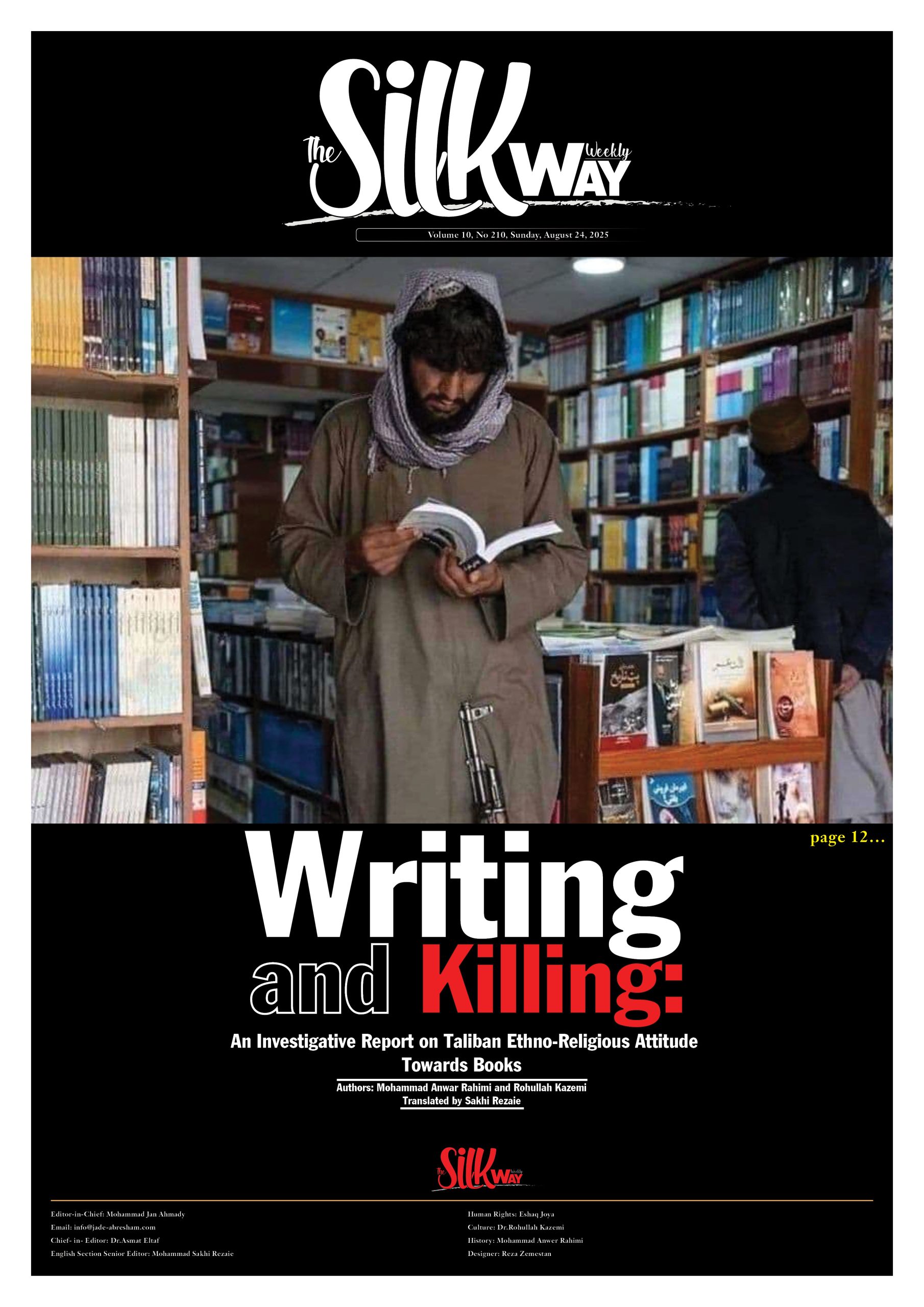
The Taliban intelligence forces are very arbitrary in inspecting banned books, regardless of the list of banned books. They take away any type of book they want without paying or providing a valid reason. This is despite the fact that most of these people are not literate enough to read books. Booksellers are also silent in front of them without any reason and for fear of harassment and humiliation.
On 10 January 2024, Taliban intelligence forces abducted Naser Maqsudi, the owner and head of Maqsudi Publishing House, from his library in Pul-e-Sorkh, Kabul, after severely beating him. Sources told the Silk Way Weekly that after the Taliban forces confiscated several books from Maqsudi Publishing House, including “Hazaraha From Massacre to Reviving Identity by Basir Ahmad Dawlatabadi, they encountered Mr. Maqsudi’s resistance and, as a result, beat him. Maqsudi was injured in the Taliban beating and was transferred to Ibn Sina Hospital for treatment. At the same time as Maghsoudi was beaten, Qasem Farzam, head of the Wazha Publishing House, wrote on his Facebook page: “Once again, they came to the bookstores and took away many books. Unfortunately, they also forcibly took away one of our colleagues who had prevented them from doing so, brutally throwing a bag over his head and severely beating him.”
One publisher, who is afraid to be named, says: “It is not clear to us why they are taking these books; because they are not interested in reading books and do not like them at all, perhaps they are sensitive to seeing some of the images, or they want to discourage booksellers from continuing their work.” The source also emphasizes that whatever it is, we do not know, but the financial losses that are being suffered by the poor booksellers are irreparable. The source adds that the Taliban are warning publishers about books written in criticism of tribal governments that they will be severely punished if they publish, distribute, or buy and sell these books.
Mohammad Hassan Shariati, the director of Irfan Publishing in Kabul, told Silk Way on 1 June 2023 about banned books: “In the meetings they invited us to, we were told, ‘Promise that you will not sell books that are suspicious and against our demands. After the promise, if our intelligence agency finds banned books in your shops, then there will be both a fine and imprisonment.”
Another publisher in Pul-e-Sorkh says that he has collected a number of literature and novels, some books on political science, philosophy, feminism (women’s rights), and some famous books that have more customers but are not in line with the Taliban’s ethno-political ideology and religious beliefs from bookstores and libraries and has banned their sale and purchase.
Publishers say that Taliban forces have a two-pronged approach to booksellers. According to sources, the Taliban are very harsh with Persian-speaking booksellers, especially Hazaras. “They inspect bookstores at least twice a month. These forces use ethnic and derogatory words when dealing with booksellers. But with Pashto publishers and booksellers, they are kind and have a friendly and empathetic approach.” According to sources, so far, books related to religion, history, culture, language and identity of the Pashtun people have not been listed among the banned books. These sources cite four main reasons for this two-pronged approach:
First: Pashtun booksellers are no different from the Taliban in terms of ethnicity, religion and language. Therefore, the Taliban government has no problem with them.
Second: Most Pashto-speaking booksellers sell religious books, textbooks on experimental sciences, and books related to the history, culture, identity, and language of the Pashtun people.
Third: Most Pashto-speaking booksellers do not have works related to Western philosophy and literature, books related to human rights, feminism, criticism of Pashtun governments, and works related to the identity and culture of other ethnic groups in their libraries.
Fourth: The Taliban’s view of profit from buying and selling is also ethnically biased. For this reason, they pressure Persian-speaking booksellers to stop selling books and create a platform for more activity by booksellers of their own descent and language.
Even publishers and booksellers of Pashtun descent who publish and buy and sell books on the history of other ethnic groups or the humanities are sometimes interrogated. A source told Silk Way: “Amiri Publishing and Bookstore, which is somewhat professional in publishing and trading books and most of its customers are Hazaras, once had the father of the franchise owner of this publication arrested and tortured by the Taliban.”
Another source, who did not want to be named in this report, said: “After the Taliban took over, the import of books from Iran has faced many restrictions, while the import of books printed in the Peshawar storytelling market from Pakistan does not face any restrictions. The reason is that the traders of Pakistani printed books are mostly Pashtuns and the traders of Iranian printed books are mostly Hazaras and Tajiks. Recently, even novels are not allowed to enter and are confiscated at the Islam Qala border.” Asif (pseudonym) told the Silk Way: “A number of booksellers who had imported some books on literature and novels and some textbooks on experimental sciences from Iran, about a fifth of these books were stolen at the border and did not reach the booksellers.”
The Slaughterhouse of Religious Pluralism
The Taliban regime is a slaughterhouse for religious pluralism and a pit that has opened its mouth on the basis of religious negation and pluralism. The takfir and elimination of Hazaras on the basis of religion and race in Afghanistan goes back at least to the genocides of Abdul Rahman against the Hazaras. But in the last circle of this takfir, Noor Mohammad Islam Jarr in 2020, by writing the book “Al-Aqeedah Al-Matridiyyah”, called the Shiites polytheists, collaborators of the infidels and enemies of the companions. This takfir and elimination had also been clearly and decisively proposed in the book of the Taliban judge, Maulvi Abdul Hakim, entitled “Al-Amara Al-Islamiyyah Wa Nizamah”. Also, Nada Mohammad Nadim, the acting minister of higher education for this group, in a speech at Sayyid Jamaluddin University in Kunar Province on 2 December 2023, declared only the Hanafi school of thought as the official religion, while concealing other schools of thought, and considered it the main factor in success in the wars in Afghanistan.
The divisive statements of Nadeem and the book of Mawlawi Abdul Hakim and Islam Jar are being fed to the minds of the militias of this military regime in a situation where more than a quarter of the population of Afghanistan follows the Twelver Shia sect and a large group of the people of this country follow the Ismaili, Hanbali, Shafi’i and Maliki sects, and a population of followers of the two religions Sikhs and Hindus also continue to live in Afghanistan and, based on human values, they should enjoy equal citizenship rights and religious freedom like the followers of the Hanafi sect. These ignorant statements not only lead to division and exclusionary conflicts; but also show that bigotry and violence are being practiced and distributed from the government against religious and ethnic classes. The decree to collect books that differ from Hanafi jurisprudence and replace them with books on the biography of the Prophet by Nida Mohammad Nadeem, the acting Taliban Minister of Higher Education, on 21 December 2023, is a violent purge carried out by the government and governors of the Taliban regime. In a situation where ethnic and religious differences are the most objective and irreducible realities of Afghanistan, the writings and statements of Taliban officials, while being considered the utmost irresponsibility and deliberate humiliation of society, also mean that we should call such writings and statements a manifesto for the spread of violence and cruelty in society.
According to the Silk Way’s findings, the Taliban immediately began collecting books related to the history, culture, and identity of non-Pashtun ethnic groups, especially the Hazaras, to implement these manifestos and decrees. Hamid (pseudonym) says: “Although this letter was issued to all private higher education institutions, the Taliban, under the pretext of collecting books that contradicted Hanafi jurisprudence, mostly went to the libraries of private Hazara and Tajik universities and collected mostly books that contradicted their ethnic ideology and policies.” According to sources, if the Taliban had collected books that contradicted Hanafi jurisprudence, no books would have remained in university libraries by now, which means that in Afghanistan, slogans are still religious and practices are racial.
Ban on teaching Ja’fari jurisprudence
On 9 September 2023, Habibullah Agha, the acting Taliban Minister of Education, issued a decree ordering all school principals across Afghanistan to stop teaching books related to Shia beliefs. According to this decree, the Taliban Ministry of Education banned the teaching of any Jafari jurisprudence books. This decree was issued while during the previous government, Jafari jurisprudence books were taught in universities and public and private schools for Hazara students.
Following the order of the group’s education minister, Inayatullah Sahar, the Taliban’s education director in Bamyan, on 9 June 2024, issued an order to collect Jafari jurisprudence textbooks from schools in the province. According to sources, this order was issued at a time as about 90 percent of the population of Bamyan province is Shia and there is not a single Hanafi family in Yakawlang 1, Yakawlang 2, Punjab, and Wars districts. According to the constitution of the previous government, Jafari jurisprudence textbooks were taught to students in Bamyan schools. Now these books have been collected and have not yet been replaced. Hussain (pseudonym) tells Silk Way: “The Taliban’s education director knew that most of the people of Bamyan are Hazara and Shia. The purpose of collecting Jafari jurisprudence textbooks is to oppose the culture and identity of the Hazara people. In this way, the Taliban wants to impose their ethnic dominance on the Hazaras.”
The Taliban’s childish argument was that “on the one hand, teaching both jurisprudences causes disagreements among people, and on the other hand, religious questions for the entrance exam are selected from Hanafi jurisprudence books, so this jurisprudence should be taught. However, the Taliban’s main goal in doing this is to oppose the religious beliefs and human and cultural identity of the Hazaras.” The text of a letter issued by the Taliban’s Education Department in Bamyan, addressed to the Education Department of the Waras district of that province, states:
“To the respected Education Department of Waras District!
Assalamu Alaikum,
Subject: Collecting Islamic education textbooks that are taught from one jurisprudence.
All schools that have students from two schools of jurisprudence (Hanafi and Ja’fari) and whose textbooks are from one jurisprudence are instructed to collect the books of the aforementioned schools by the end of the formalities on Thursday, 9 June 2025, until new books are prepared and distributed for the use of both schools of jurisprudence.”
The subject has been informed to you, please take the necessary action.
Assalamu Alaikum
Qari Inayatullah Sahar,
Director of Education of Bamyan
In this letter, he ordered the collection of Ja’fari jurisprudence textbooks so that later books related to both jurisprudences could be replaced for students. Following this order, according to sources, only books related to Ja’fari jurisprudence were collected, but Hanafi jurisprudence textbooks were not collected. At the same time, a replacement for Ja’fari jurisprudence, according to the aforementioned letter, has not yet been produced.
On 18 November 2024, Silk Way received a report from local sources in Daykundi that Mustafa Saleh, the head of Taliban information and culture in the province, had announced in a press release that books that were against Taliban principles and regulations would be collected from libraries and bookstores in Daykundi province. Following this order, books of Jafari jurisprudence and resources related to the historical identity of the Hazaras were collected from all over Daykundi province. These orders and actions by the Taliban led to the closure of the Islamic Revolution of Afghanistan Library in Jaghori district on 19 November 2024; while according to the sources, “the library in question does not belong to any group or political party and the purpose of establishing and operating this library was to provide people with access to the books they needed. ”
Even the poor Shiite pilgrims were not spared from this political-religious tragedy and were harassed at the borders. On 19 September 2024, local sources in Herat told Jaade Abrisham that Taliban officials at the Islam Qala border confiscated books of Mafatih al-Jinan and other religious prayer books, some prayer clays, and a shroud that Hazara and Shiite pilgrims had brought with them from Iraq and Iran. According to these sources, a vehicle of Karbala pilgrims traveling from Mashhad to Herat was inspected by Taliban officials. The Taliban forcibly seized 30 volumes of books (including Mafatih al-Jinan, Ziarat al-Ashura, and Ertebat ba Khoda (Relation with God), 20 shrouds, and some prayer clays from the pilgrims, insulting and humiliating them, calling them takfir and polytheists.
One pilgrim told the Silk Way: “The Taliban agents inspected all our belongings at the border. When they saw the books, prayer clays, and shroud, they threw our belongings on the ground and trampled them with mockery, insults, and violence. They told us that we were infidels and polytheists. Then they confiscated all the books, turbah, shrouds, and a number of other souvenirs and took them away.”
Closing reading rooms
The Taliban have not only banned books, but also the culture of reading. Since the republican era, some libraries in western Kabul had provided reading rooms for their customers, but the Taliban have closed all reading rooms to women and girls.
A female student told Silk Way: “The Taliban have closed the reading rooms for girls in most bookstores in western Kabul. One bookstore, whose name I do not wish to mention in the report, had previously set up a special reading room for girls; but last winter, this room was closed on the orders of the Taliban.”
She adds: “Books related to women’s rights and feminism are practically banned. I asked a bookstore for Humaira Qaderi’s novel “Dancing in the Mosque,” and they said it was banned; but they took out the English version from a hidden place and said we have it if you want it, but we can’t bring the Persian version for fear of the Taliban. At the Pul-e-Sorkh market, I asked for Siamak Heravi’s book “The Extinct Gods,” and they said it was banned, but if you really want it, we can secretly get it for you at a higher price.”
The most important reasons for the closure of special reading rooms in some bookstores are the widespread emigration of scholars, the Taliban’s ban on books that customers love, the chaotic economic situation of the people, the decline in the young generation’s interest in reading, and the increase in taxes, while the number of book customers and readers has reached an unprecedented low. Another bookseller, who fears to be named, told Silk Way: “The tax increase is another scourge that has befallen booksellers. There are no customers for books, but the tax continues to increase. This has caused most bookstores to close.”
Cultural genocide
Dr. Ghulam Haider Allama, a criminal law expert and deputy attorney general during the republic, considers Anti-book an act against human rights and says that “Anti-book is an act against human rights because it is against freedom of expression.”
Regarding the Taliban’s ban on books, Dr. Allama says that “first, the publication, printing, and sale of books should not be prohibited. In addition to the premise of banning these, the ban on books should be included in the law and that too in a very limited, narrow, and restrictive manner; so that it does not contradict human rights standards.”
According to Mr. Allama, the Taliban is an illegitimate group and does not have the authority to ban books: “Since the Taliban do not have a law, this is done within the framework of an arbitrary, authoritarian, and tasteful policy that is contrary to the principle of legality and rule of law. When there is no law, neither the court, nor the ministry, nor any other body has the authority to do so. This is because we have a legal proverb that the judge is a slave to the law and the legal body cannot issue any rulings.” Dr. Allama says, “Although cultural genocide is not included in official international documents as genocide, there is a debate among international law professors about whether it would be good if this were also included in the future.”
According to Mr. Allama, the Taliban’s ban on books related to Shiites falls within the framework of religious oppression and discrimination, which is also considered a violation of human rights and cultural genocide.
Add Comment