





 Professor Christian Reder
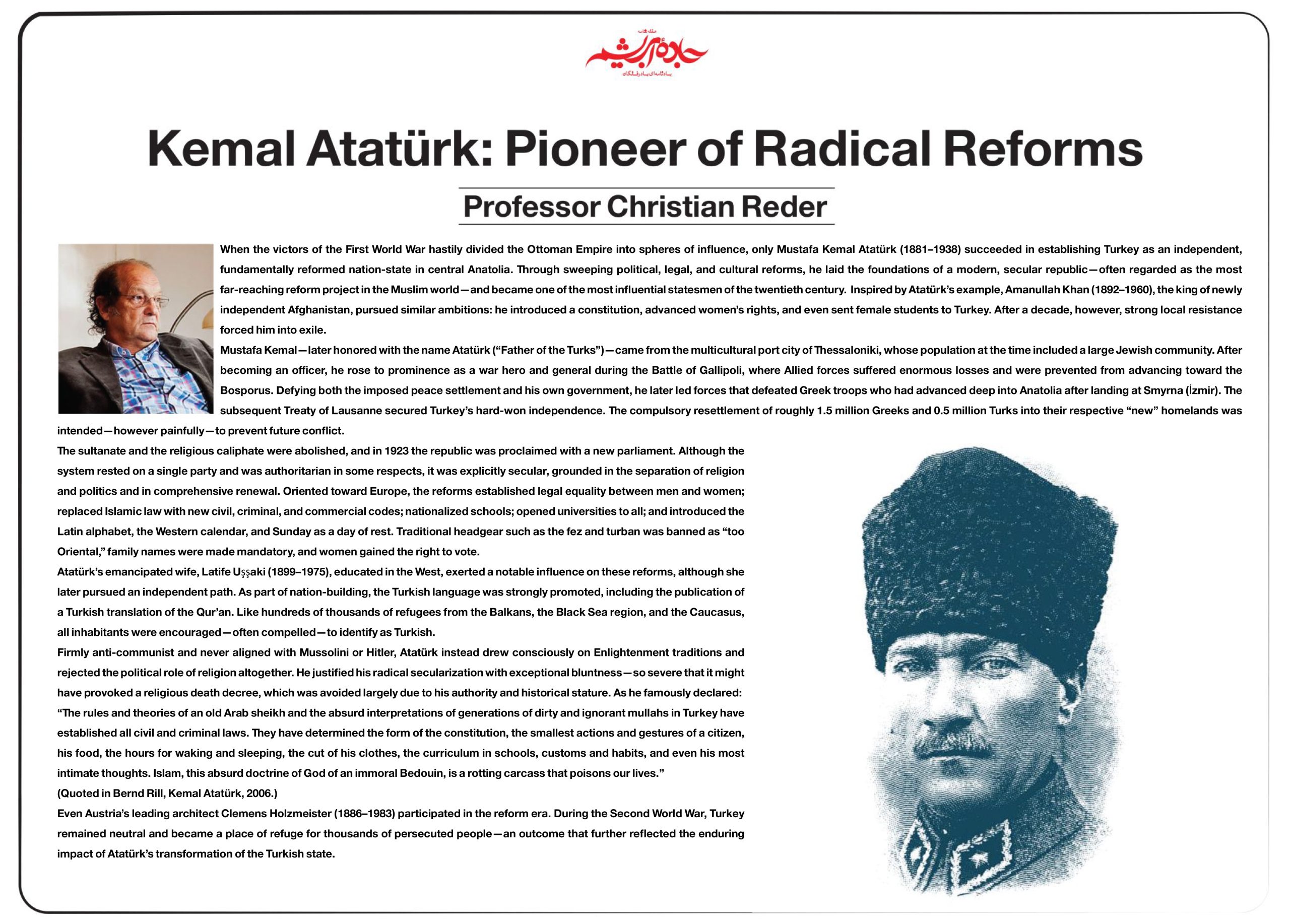
When the victors of the First World War hastily divided the Ottoman Empire into spheres of influence, only Mustafa Kemal Atatürk (1881–1938) succeeded in establishing Turkey as an independent, fundamentally reformed nation-state in central Anatolia. Through sweeping political, legal, and cultural reforms, he laid the foundations of a modern, secular republic—often regarded as the most far-reaching reform project in the Muslim world—and became one of the most influential statesmen of the twentieth century. Inspired by Atatürk’s example, Amanullah Khan (1892–1960), the king of newly independent Afghanistan, pursued similar ambitions: he introduced a constitution, advanced women’s rights, and even sent female students to Turkey. After a decade, however, strong local resistance forced him into exile.
Mustafa Kemal—later honored with the name Atatürk (“Father of the Turks”)—came from the multicultural port city of Thessaloniki, whose population at the time included a large Jewish community. After becoming an officer, he rose to prominence as a war hero and general during the Battle of Gallipoli, where Allied forces suffered enormous losses and were prevented from advancing toward the Bosporus. Defying both the imposed peace settlement and his own government, he later led forces that defeated Greek troops who had advanced deep into Anatolia after landing at Smyrna (İzmir). The subsequent Treaty of Lausanne secured Turkey’s hard-won independence. The compulsory resettlement of roughly 1.5 million Greeks and 0.5 million Turks into their respective “new” homelands was intended—however painfully—to prevent future conflict.
The sultanate and the religious caliphate were abolished, and in 1923 the republic was proclaimed with a new parliament. Although the system rested on a single party and was authoritarian in some respects, it was explicitly secular, grounded in the separation of religion and politics and in comprehensive renewal. Oriented toward Europe, the reforms established legal equality between men and women; replaced Islamic law with new civil, criminal, and commercial codes; nationalized schools; opened universities to all; and introduced the Latin alphabet, the Western calendar, and Sunday as a day of rest. Traditional headgear such as the fez and turban was banned as “too Oriental,” family names were made mandatory, and women gained the right to vote.
Atatürk’s emancipated wife, Latife Uşşaki (1899–1975), educated in the West, exerted a notable influence on these reforms, although she later pursued an independent path. As part of nation-building, the Turkish language was strongly promoted, including the publication of a Turkish translation of the Qur’an. Like hundreds of thousands of refugees from the Balkans, the Black Sea region, and the Caucasus, all inhabitants were encouraged—often compelled—to identify as Turkish.
Firmly anti-communist and never aligned with Mussolini or Hitler, Atatürk instead drew consciously on Enlightenment traditions and rejected the political role of religion altogether. He justified his radical secularization with exceptional bluntness—so severe that it might have provoked a religious death decree, which was avoided largely due to his authority and historical stature. As he famously declared:
“The rules and theories of an old Arab sheikh and the absurd interpretations of generations of dirty and ignorant mullahs in Turkey have established all civil and criminal laws. They have determined the form of the constitution, the smallest actions and gestures of a citizen, his food, the hours for waking and sleeping, the cut of his clothes, the curriculum in schools, customs and habits, and even his most intimate thoughts. Islam, this absurd doctrine of God of an immoral Bedouin, is a rotting carcass that poisons our lives.”
(Quoted in Bernd Rill, Kemal Atatürk, 2006.)
Even Austria’s leading architect Clemens Holzmeister (1886–1983) participated in the reform era. During the Second World War, Turkey remained neutral and became a place of refuge for thousands of persecuted people—an outcome that further reflected the enduring impact of Atatürk’s transformation of the Turkish state.

Add Comment